
Cross-Border Payments
How to Sell USDT in Cambodia and Cash Out to a Bank
Sell USDT in Cambodia through a currently lawful, verified route, then reconcile the original payment, blockchain transfer, conversion, fees, and bank credit.
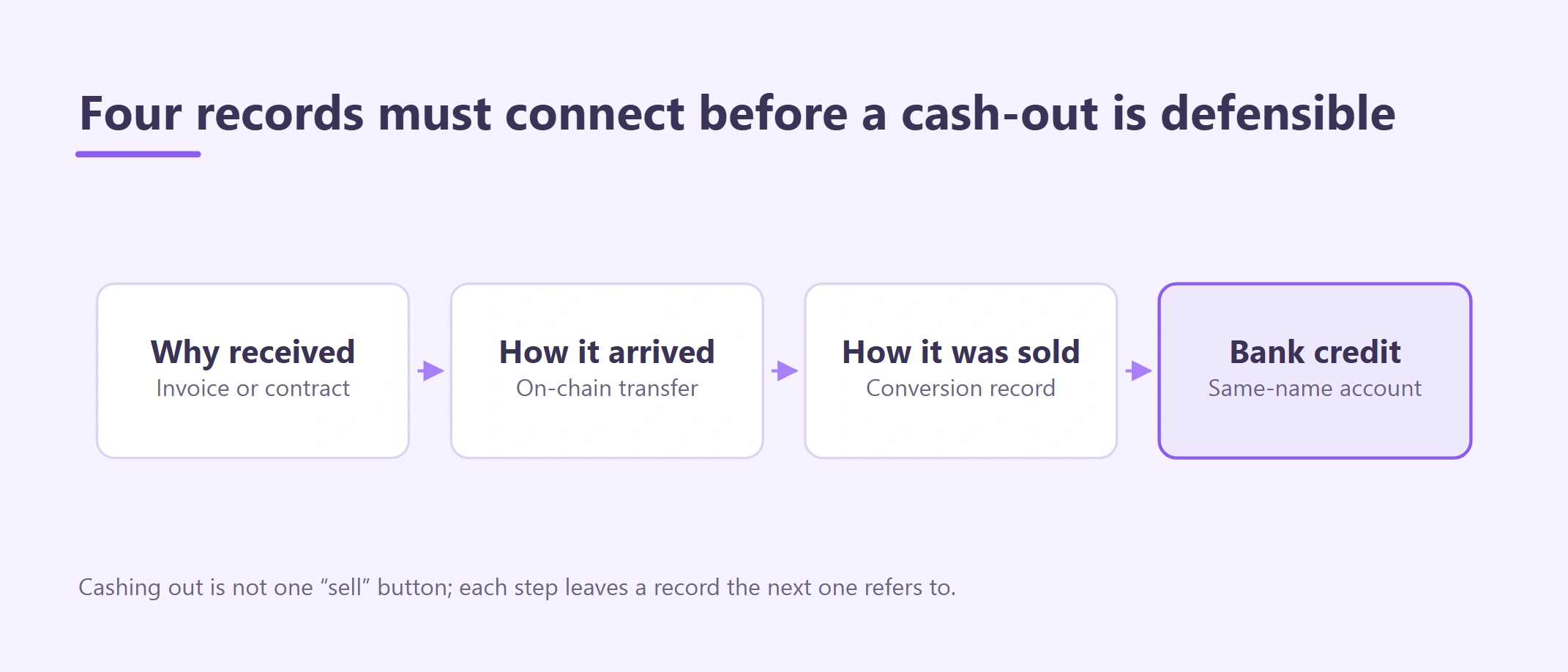
This guide explains how to sell USDT in Cambodia and cash out to a bank account while verifying that the provider and route are currently available and lawful for your facts. A defensible result connects the original payment purpose, incoming blockchain transfer, conversion record, fees, and matching bank credit. Official sources reviewed August 26, 2026.
Cashing out is not a single “sell” button. You must connect four records: why you received the stablecoin, how it reached the conversion provider, how it was sold, and how the matching fiat amount reached a bank account you control.
Use this guide for: converting already-received stablecoins into a same-name Cambodian bank account. For the incoming client-payment stage, use the accepting crypto payments from abroad.
What Cambodian regulators currently publish
The current SERC page lists firms authorized to participate in the securities-sector FinTech sandbox and describes their trial activities. As reviewed on August 26, 2026, the page lists Royal Group Exchange (RGX) with trial activities including digital-asset trading, digital-asset derivatives, wallet management and P2P trading. Other listed participants have different activity sets.
| Participant on the live SERC page | Trial activities shown |
|---|---|
| Royal Group Exchange (RGX) Co., Ltd. | Digital-asset trading, derivatives, wallet management and P2P trading |
| Wnk System Co., Ltd. | Digital-asset trading and wallet management |
| XP Experience Point Co., Ltd. | Digital-asset trading, derivatives and wallet management |
| CTX-98 Co., Ltd. | Digital-asset trading, derivatives and wallet management |
| KMC Kinesis Money (Cambodia) Co., Ltd. | Digital-asset trading and wallet management |
| Eurasia Digital Asset Exchange Co., Ltd. | Digital-asset trading, derivatives and wallet management |
Snapshot reviewed on 2026-08-26. Reopen the live SERC page before acting; inclusion is not a recommendation or proof that a specific cash-out method is operating.
This is a current verification starting point, not a recommendation, guarantee of bank withdrawal, or permission to use every product. Sandbox participation, account eligibility, supported assets, payment methods and operational status can change. Recheck the live SERC list on the day you act and verify the service through the contact/domain shown by an official source.
The NBC's current Prakas index includes a “Prakas on Transaction Related to Cryptoassets” dated December 26, 2024. Review the current NBC Prakas and Circulars and obtain qualified advice when the banking or business treatment is unclear. A provider's KYC approval does not settle your legal, tax or bank obligations.
Decide what the end result should look like
Write the intended result before moving funds:
| Field | Example |
|---|---|
| Source | USD 980 website invoice paid in USDC |
| Current holder | Your named wallet or exchange account |
| Target currency | USD or KHR, as supported by the verified route |
| Target bank | Account in the same verified legal name |
| Maximum acceptable cost | Network fee + provider fee + spread + bank charge |
| Evidence required | Contract, invoice, TxID, exchange statement and bank credit |
| Completion | Fiat is credited, available and reconciled to the invoice |
If you cannot explain the source or the bank account belongs to another person, stop before sending the stablecoin.
Choose one of three route types
Direct provider-to-bank withdrawal
The provider accepts the stablecoin, converts it and offers a bank withdrawal in your account. This is operationally simple, but only if the live account supports the currency, bank method and beneficiary name.
Local regulated or sandbox provider route
You deposit to a currently listed provider, convert under its rules and use its available payout method. Verify its current SERC status, permitted trial activity, KYC requirements, asset/network support, withdrawal method and complaint channel.
P2P transaction inside an eligible provider
You sell to a verified counterparty under the provider's escrow and order flow. This introduces counterparty, bank-payment and dispute risk. Never move the conversation off-platform, accept a third-party payer without a documented lawful reason, or release stablecoins before the bank credit is visible and available under your bank's normal checks.
Avoid informal street dealers, social-media brokers and “cash agents” that cannot provide a verifiable legal identity, transaction record and complaint path.
How to sell USDT in Cambodia and verify the bank credit
1. Build the source-of-funds file
Collect contract, invoice, customer identity appropriate to the transaction, payment instruction, incoming TxID, wallet/exchange statement and any correspondence explaining the commercial purpose. The amount and dates should form one consistent chain.
Read accepting crypto payments from abroad and the KYC/AML overview.
2. Verify the provider on the day of use
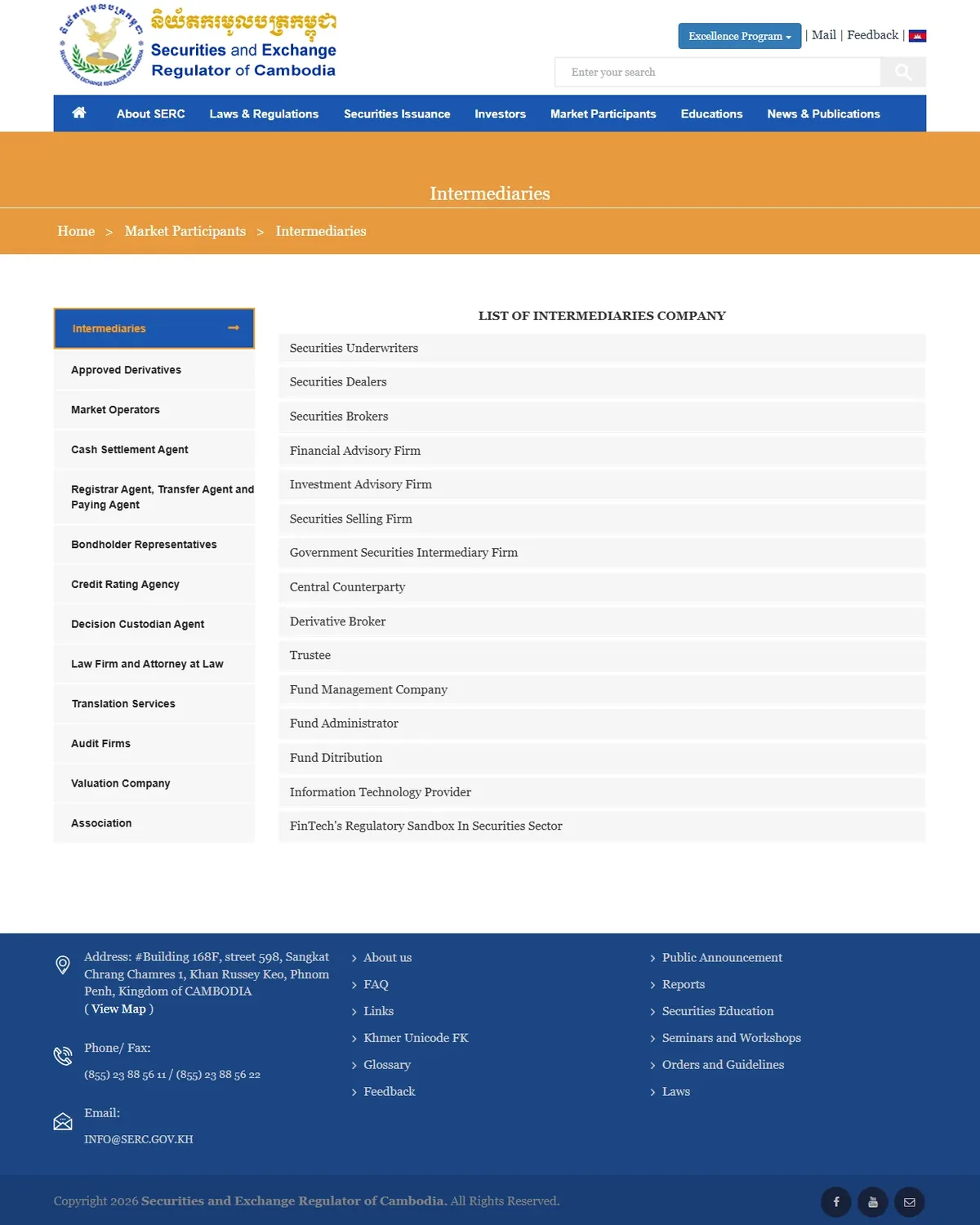
Official SERC Intermediaries page, captured 2026-08-26. Open “FinTech's Regulatory Sandbox In Securities Sector” and read the current firm and trial-business rows; inclusion is not an endorsement or a bank-withdrawal guarantee.
Start from the live SERC list, not a search advertisement or referral message. Confirm the company name, authorization entry, trial activity and official contact. Then confirm in the provider's current account or terms:
- Cambodian-resident eligibility;
- personal versus business account type;
- accepted stablecoin and exact networks;
- deposit minimum and confirmations;
- conversion or P2P availability;
- supported fiat and bank payout method;
- same-name beneficiary rule;
- fees, spread, limits, review triggers and complaint process.
If the SERC entry and provider claim conflict, stop and verify with SERC or qualified local counsel.
3. Complete KYC with matching identity
Use accurate residence, legal name and genuine documents. The provider account and bank beneficiary should match the person or business that owns the funds. Do not use a relative's bank account or buy a verified account to work around eligibility.
4. Generate a live deposit route
Select the stablecoin and network on the receiving provider first. Copy its fresh address and memo/tag. Confirm the sending wallet supports the same asset/network and review all deductions. Never use an address from this article or a screenshot.
5. Send a small test deposit
Send an amount above the provider's displayed minimum but small enough to limit loss. Wait for the provider's credited balance, not only the sending wallet's success status. Record the TxID and fee. Use the crypto test transaction guide.
6. Send the balance and preserve evidence
Reconfirm the route and send the remaining amount. Do not split transfers to avoid review. Save deposit records and account statements.
7A. Convert and withdraw to bank
If the provider offers direct conversion and bank withdrawal, preview:
- stablecoin amount sold;
- exchange rate and spread;
- trading/conversion fee;
- withdrawal/bank fee;
- expected fiat amount;
- beneficiary name and bank details;
- expected processing status and support reference.
Submit only when the beneficiary is correct and the total result is acceptable. Test a small bank withdrawal first where practical.
7B. Use P2P only with escrow and verified bank receipt
If using an eligible provider's P2P trial activity:
- choose the correct sell side, fiat currency and payment method;
- review the counterparty's completion history, terms and legal name;
- keep communication and payment inside the official order flow;
- compare the payer name with the verified counterparty;
- inspect your bank account independently—never trust a screenshot or SMS alone;
- release only after the correct amount is credited and available;
- use the platform dispute/appeal process if names, amounts or instructions differ.
Do not accept an off-platform premium in exchange for losing escrow protection.
8. Reconcile bank receipt to the original invoice
Record:
Net bank proceeds = fiat received − all provider, spread, network and bank costs
Link the original invoice, incoming stablecoin TxID, provider deposit, conversion/P2P order, fees and bank credit. Keep the exchange rate and timestamp used for accounting. Do not record the stablecoin's face value as bank proceeds if the actual amount differs.
Worked USD 980 example
| Stage | Evidence to retain |
|---|---|
| Client pays USD 980 invoice in USDC | Contract, invoice, agreed rate and incoming TxID |
| Test deposit to verified provider | The route details you checked that day, test TxID, credited amount and fee |
| Main deposit | TxID and provider statement |
| Conversion or P2P sale | Order ID, rate, spread/fee and counterparty record where applicable |
| Bank payout | Same-name beneficiary, credited amount, date and bank reference |
| Final reconciliation | USD 980 receivable, actual costs, net proceeds and any difference |
The example does not promise that USD, KHR, USDC or a particular bank method is offered. Replace every route field with the values shown in your current eligible account.
When to stop, and what to do instead
| Problem | Stop or continue? | What to do |
|---|---|---|
| Provider not on the current official list or status unclear | Stop | Verify with SERC; do not rely on ads or screenshots |
| Stablecoin/network not supported | Stop | Choose a route supported by both sides; do not guess |
| Deposit test not credited | Stop | Check TxID, network, memo and minimum; use official support |
| KYC or source-of-funds review | Pause | Submit genuine requested records through secure official flow |
| Bank beneficiary differs from verified owner | Stop | Correct the account; do not use a third party as a workaround |
| P2P payer name or amount differs | Do not release | Open an in-platform dispute and preserve evidence |
| Buyer sends only a screenshot or marks paid | Do not release | Verify independent bank credit and availability |
| Bank/provider freezes or returns funds | Pause | Preserve records, ask for the written reason and use official complaint paths |
| “Agent” asks for seed phrase, OTP, remote access or extra wallet fee | Stop | Treat as scam and report through official channels |
Review crypto scam red flags before any P2P transaction.
The cash-out record is complete when
Cash-out is complete only when:
- the provider's current official status and relevant activity were checked;
- account, source-of-funds and bank-owner identities are consistent;
- the live asset/network route was tested successfully;
- conversion or P2P order records are complete;
- bank funds are credited and available;
- all fees and exchange-rate differences are recorded;
- invoice, TxIDs, provider statement and bank receipt reconcile;
- no dispute, review or unexplained third-party payment remains.
If no route passes every check, “do not cash out yet” is the correct completed decision—not a reason to bypass rules.
Reconcile a USDT sale to USD or KHR bank credit
Use the bank's actually credited currency as the final cash-out result. Do not label a transaction “one-to-one” merely because USDT references the US dollar.
| Reconciliation field | Value to record |
|---|---|
| USDT sold | Gross amount and network |
| Sale order | Provider/order ID and RFC3339 time with offset |
| Quoted result | USD or KHR amount before costs |
| Executed result | Actual rate and fiat amount after spread |
| Explicit costs | Trading, provider, network and bank fees |
| Bank credit | Amount, currency, beneficiary and bank reference |
| Difference | Quoted result minus actual available bank credit |
For a KHR payout, keep both the executed USDT-to-KHR rate and the bank-credit amount. If an intermediate USD conversion occurred, record that leg instead of inventing one direct rate. Reconcile the provider statement and bank entry line by line; a rounded message or buyer screenshot is not accounting evidence.
If the payer name, beneficiary name, order amount or bank credit does not match, leave the transaction unresolved and use the provider's official dispute or support process. Do not change the original invoice to force the numbers to agree.
Official sources
- SERC: Current FinTech Regulatory Sandbox List
- NBC: Prakas and Circulars
- FATF: Virtual Assets
- Circle: USDC Access and Redemption Information
- Tether: Transparency
Educational information only, not legal, tax, banking or financial advice. Confirm current Cambodian requirements and provider/bank terms before acting.