
Security & Compliance
Crypto Test Transaction: Verify Status Before Sending More
Size a crypto test transaction above live minimums, verify the TxID on the correct block explorer, confirm the account was credited, and decide on evidence.
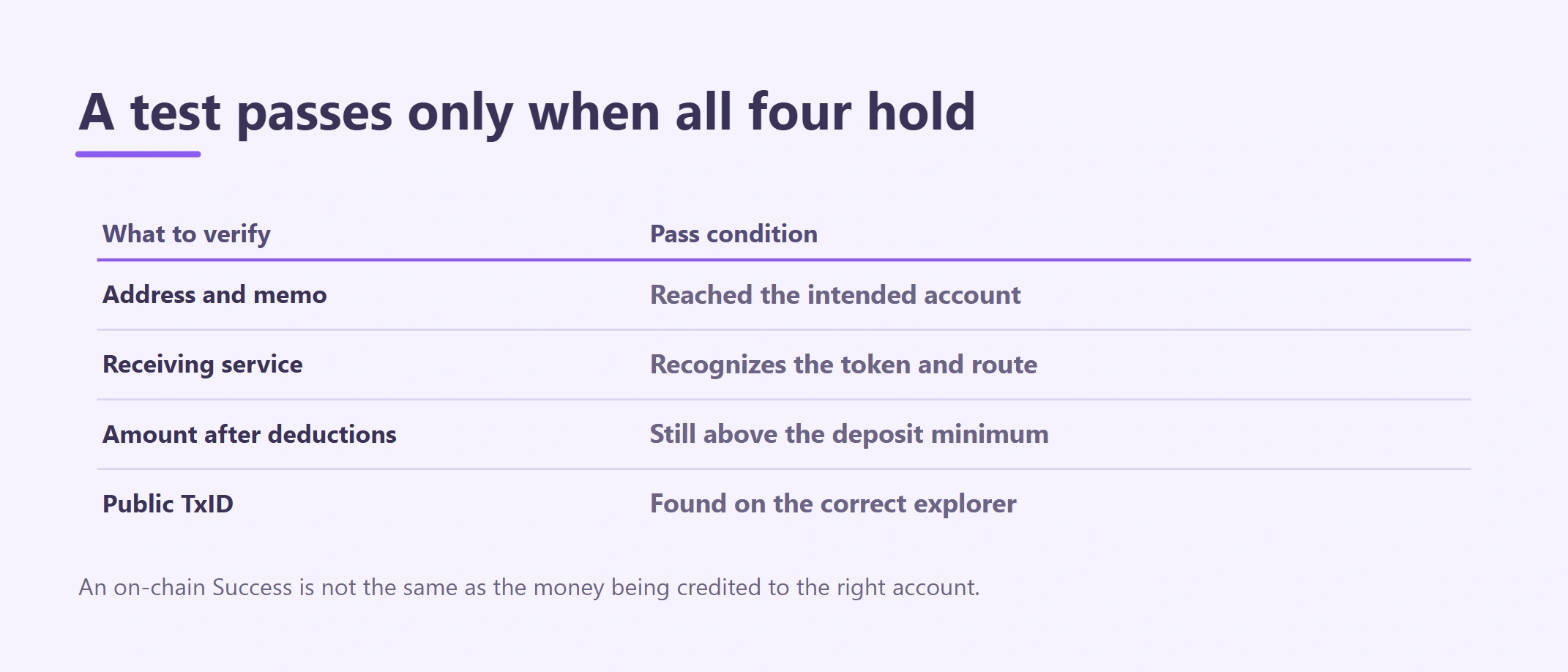
A crypto test transaction answers one narrow question: can this exact sender, asset, network, destination, and memo produce a credited balance now? It must clear the receiver’s live minimum after deductions, remain small enough to limit loss, and be verified by both the correct block explorer and the destination balance. Official sources reviewed August 26, 2026.
Use the method for a new wallet, exchange deposit route, recipient or materially changed transfer path. The result is not merely a successful explorer status; it is a documented decision to proceed, rebuild the route or keep the main amount in place.
This article begins after the asset and network have been chosen. If the route is not yet fixed, start with the choosing a USDT or USDC network.
What a test transaction proves—and what it does not
A credited test can demonstrate that, at that time:
- the sender used the intended asset and network;
- the pasted address and memo or tag reached the intended account;
- the receiving service recognized the token and route;
- the test remained above the deposit minimum after deductions;
- the public TxID could be found on the correct block explorer;
- the recipient could see and reconcile the credited balance.
It does not prove that the recipient is trustworthy, a later address will stay the same, the network will remain available, a larger payment will avoid review, a stablecoin will keep its peg, or the transaction is lawful. It is one control inside the broader crypto network fees and confirmations.
Decide in advance what the test must prove
Write down, with the date, what a successful test should look like. Fill it in from live screens immediately before the transfer.
| What to settle | Where the answer comes from |
|---|---|
| Sender and destination | Named accounts or wallets involved in this test |
| Asset and network | Exact pair displayed at both endpoints |
| Address and memo/tag | Fresh destination values from the receiver |
| Live minimum | Smallest amount the receiver says it can credit |
| Deductions | Sender fee and expected net receipt |
| Test amount | Above the minimum after deductions, yet tolerable if delayed or lost |
| Pass condition | Correct TxID, expected network result and credited destination balance |
| Expiry condition | Any field change, suspension, account change or unresolved warning |
This belongs to this one test. It is evidence for a decision, not a permanent address book entry.
Choose an amount from live limits, not a universal number
There is no safe fixed test amount for every route. Minimum deposits, withdrawal charges, token prices and provider rules can change. Use the live preview immediately before authorization.
The amount must satisfy both conditions:
Expected credited test = amount sent − deductions taken from the sent amount
Expected credited test > receiver’s current minimum, with a reasonable buffer
The test should also be small enough that a delayed or unrecoverable route is tolerable. If the minimum plus fees makes the test uncomfortably large, the route is unsuitable for experimentation; choose a route both parties already support or use another payment method.
Illustrative USD 500 invoice
This is a calculation example, not a live quote or real customer case. A client owes the equivalent of USD 500 in an agreed stablecoin. The parties first read the receiver’s current minimum and the sender’s fee preview. They choose a test that remains safely above that minimum after deductions. Only after the test credits the intended account do they calculate the remainder as:
Remaining payment = agreed invoice amount − amount actually credited from the test
They do not subtract the amount originally requested if a sender-side deduction reduced what arrived. The invoice records the test TxID, credited amount, main TxID, fees and total credited value.
The order to do it in
- The recipient opens a fresh receive or deposit screen in the intended account.
- Both parties compare the asset, exact network and token identity.
- The recipient communicates the address and memo/tag requirement through an authenticated channel.
- The sender pastes the destination and compares the full value where the interface permits.
- The sender reviews the live minimum, fee asset, deduction method and expected recipient amount.
- The sender authorizes only the test amount in private.
- Both parties save the public TxID and the platform withdrawal/deposit reference.
- They inspect the TxID on the correct block explorer.
- The recipient waits for the intended account—not only the explorer—to show the credited asset and net amount.
- Both parties record the result and reopen the route before calculating the main payment.
If a new address appears, a memo requirement changes, the route enters maintenance or the sender switches networks, the previous test no longer validates the new route.
Read the transaction lifecycle correctly
The Ethereum documentation describes a transaction moving from a cryptographically generated hash to network broadcast, block inclusion and stronger finality. Other networks use their own terminology and confirmation models, but the practical lesson is the same: a transaction has states, and a wallet’s “sent” notification is only one observation.
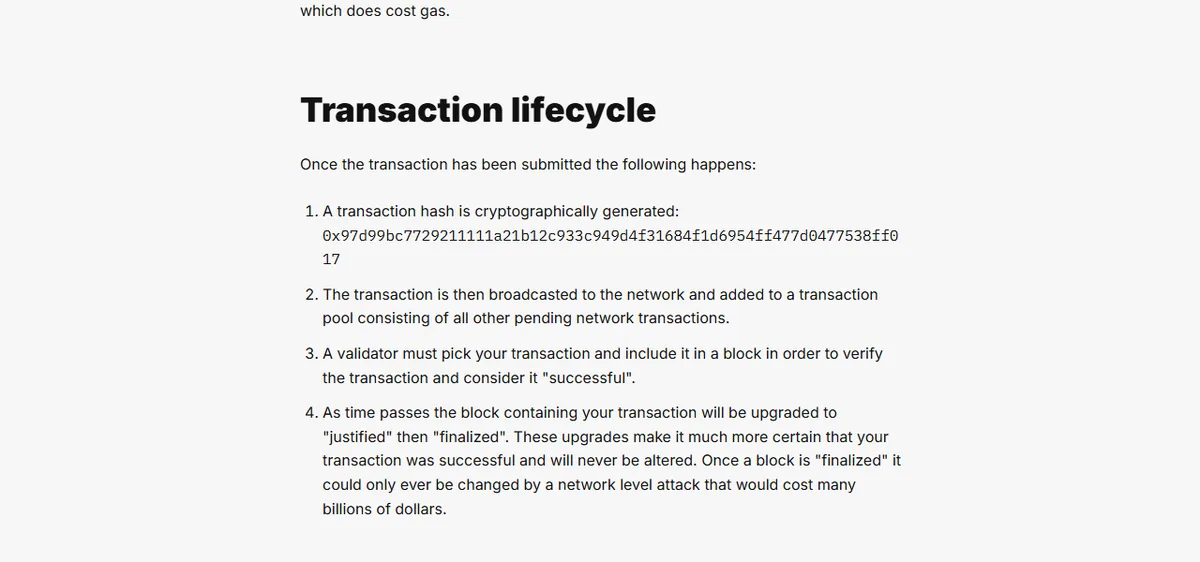
Ethereum.org developer documentation, captured 2026-08. The screenshot explains one network’s lifecycle; use the official documentation and explorer for the network actually selected.
A block explorer exposes public network data; it does not prove that a centralized service has credited a user account.
Check the crypto transaction ID on the correct block explorer
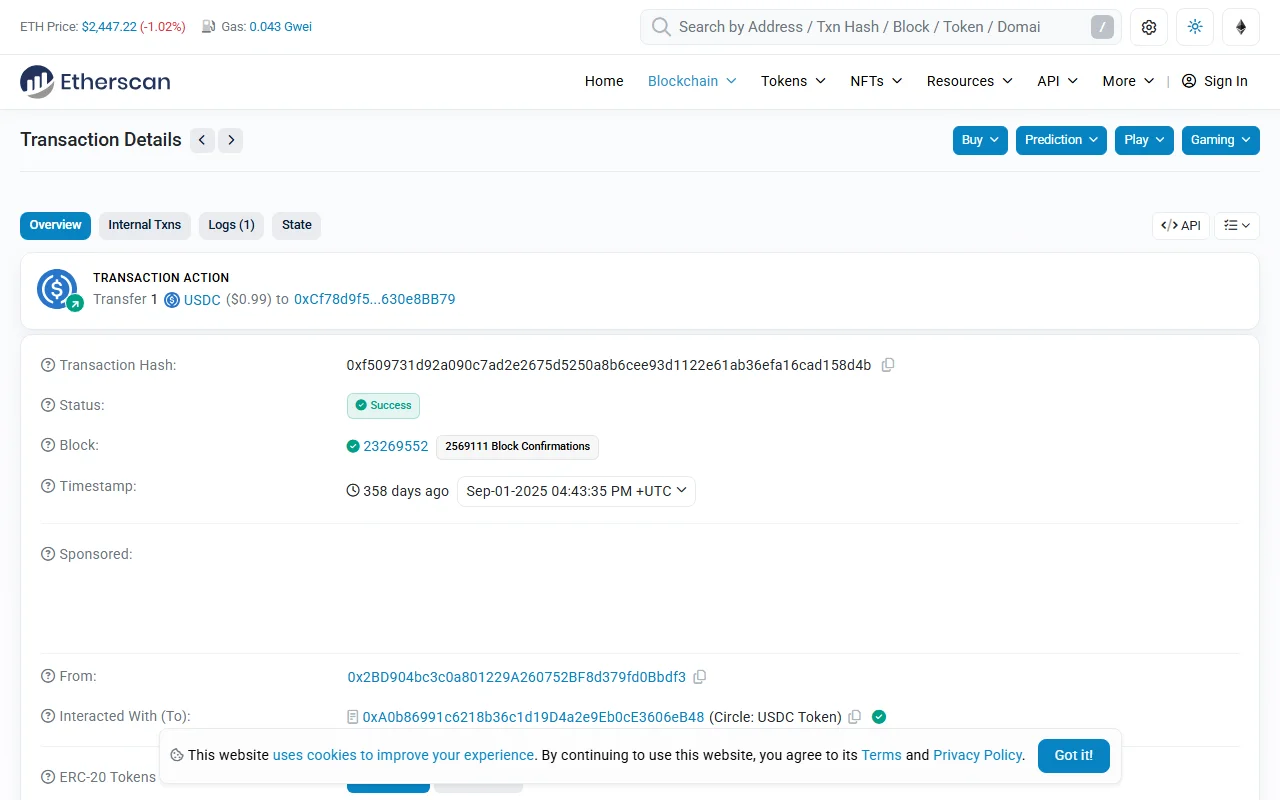
Public Etherscan transaction captured on 2026-08-26. It is an unrelated on-chain example, not a StablePay Guide payment. Match the explorer to your network and verify your own hash, addresses, amount and fee.
Open the explorer from the network’s official documentation or a trusted provider page. Do not use a link sent by an unverified counterparty. Looking up a public TxID does not require a wallet connection or any secret.
Check these fields:
| Explorer field | What to confirm |
|---|---|
| Network | The explorer belongs to the selected chain |
| Status | Pending, successful, failed, dropped or replaced as defined by that network |
| Transaction hash | Matches the withdrawal or wallet record exactly |
| From and To | Destination matches the verified route; sender may be a provider hot wallet |
| Token/contract | Correct asset identity, not a look-alike token |
| Amount | Public transfer amount matches the expected on-chain amount |
| Block/time | Plausible timing and block inclusion |
| Fee | Network fee; do not confuse it with provider withdrawal or conversion charges |
A screenshot labeled “Success” is not enough. Search the TxID yourself and compare the fields. Never paste a seed phrase into a “transaction checker.”
Separate on-chain confirmation from account credit
There are at least three distinct states:
- Broadcast or submitted: the sender created a transaction or withdrawal request.
- Confirmed on-chain: the correct network included the public transaction.
- Credited by the destination: the intended wallet or provider balance shows the correct asset and amount.
A centralized service may wait for more confirmations, apply a minimum, require a memo, pause deposits or review the account. Therefore “confirmed on-chain” can coexist with “not credited.” The test passes only when the agreed destination can actually use or account for the funds.
For a self-custody wallet, the token may not appear automatically even though the public transaction is correct. Verify the official token contract and wallet support before adding a token view. Do not import an address or contract copied from a random message.
Decide from evidence, not from a feeling
Pass only when all of the following are true:
- the asset, token identity and network match what you recorded;
- the destination and memo/tag are correct;
- the TxID is visible on the correct explorer with the expected result;
- the intended account credits the expected asset above the live minimum;
- the credited amount and deductions reconcile;
- neither platform shows maintenance, restriction or a new destination;
- both parties save the result before the main transfer.
Fail or unresolved when any field differs, the transaction remains pending beyond the network/provider’s current guidance, the explorer succeeds but the account does not credit, or support cannot confirm the route. Do not send the remainder to “see whether it works.”
Diagnose a failed or missing test
| What you see | Likely checks | Next safe step |
|---|---|---|
| No TxID from provider | Withdrawal still processing, rejected or not submitted | Check the official withdrawal record and status page |
| TxID not found | Wrong explorer, delayed broadcast or fake reference | Reopen the network’s official explorer; contact official support |
| Transaction failed | Network execution failed | Do not resend until the cause and fee implications are understood |
| Success, wrong destination | Address substitution or entry error | Stop; preserve evidence and contact providers immediately |
| Success, no account credit | Confirmations, minimum, memo, unsupported token or paused deposits | Open one official case with the TxID and route details |
| Credited wrong asset/view | Token identity or wallet display issue | Verify the official contract and destination support |
| Credited less than expected | Sender deduction, provider fee or amount error | Reconcile before calculating the remainder |
Recovery may be impossible or may involve a provider process and fee. Nobody should request your seed phrase, private key, password or OTP to investigate a public transaction.
Know when the test must be repeated
Run a new test when any material route element changes:
- a new recipient or receiving account;
- a new address or memo/tag;
- a different asset, token contract or network;
- a different sender or withdrawal provider;
- a route that was under maintenance or unavailable;
- a long gap since the previous use;
- a wallet restoration, account migration or security incident;
- an amount or compliance threshold that changes how the provider handles the payment.
Do not assume that similar address formats indicate compatible networks. Do not switch to a cheaper network after a successful test without testing the new route.
Record the test and calculate the main payment
Keep the transfer details you recorded, screenshots of the live fee and minimum where permitted, the test TxID, provider references, the credited amount and the date and time with timezone. For an invoice, record the test and the main payment as parts of the same settlement.
Calculate the remainder from the amount actually credited, not from the amount typed into the sender form. Reopen both live screens before the main transfer. If the address, memo, network, fee treatment or status changed, stop and rebuild the route.
The task is complete when the test is independently verified, the intended account credits the correct asset, the numbers reconcile, and both parties know whether to proceed, rebuild the route or use another payment method. Choosing not to send the main amount after an unresolved test is a successful safety outcome.
What to include when you contact support
When the explorer and credited balance disagree, open one case with the party that controls the missing credit. A complete packet reduces repeated questions:
- transfer direction: deposit or withdrawal;
- provider and account reference, with sensitive fields masked;
- full asset name, token contract where relevant, and network;
- amount sent, sender deduction and expected net credit;
- destination address and memo/tag exactly as used;
- TxID and a link to the correct explorer;
- broadcast time and latest checked time, both with timezone offsets;
- current explorer result and confirmation count;
- sender status, receiver status and live minimum evidence;
- what changed since the last successful use of the route.
Ask a narrow question: “Does this destination support this exact asset-network pair, and what condition is preventing credit?” Do not open multiple cases for the same transfer unless the official channel tells you to. Never attach a seed phrase, private key, password, OTP or an unmasked identity document to an ordinary support message.
Current first-party references used for this review:
- Ethereum.org: transactions
- Ethereum.org: block explorers
- Coinbase Help: steps to receive crypto
- Binance Academy: deposit and withdrawal guide
- Circle: USDC terms
Educational information only; not financial, legal, tax or investment advice. Network and provider rules can change, and a successful test cannot remove all transfer, counterparty, stablecoin or compliance risk.