
Crypto Basics
Crypto Network Fees and Confirmations: How Transfers Work
Understand crypto network fees, token contracts, address and memo matching, confirmation status, provider credit, and why a ticker alone does not define a route.
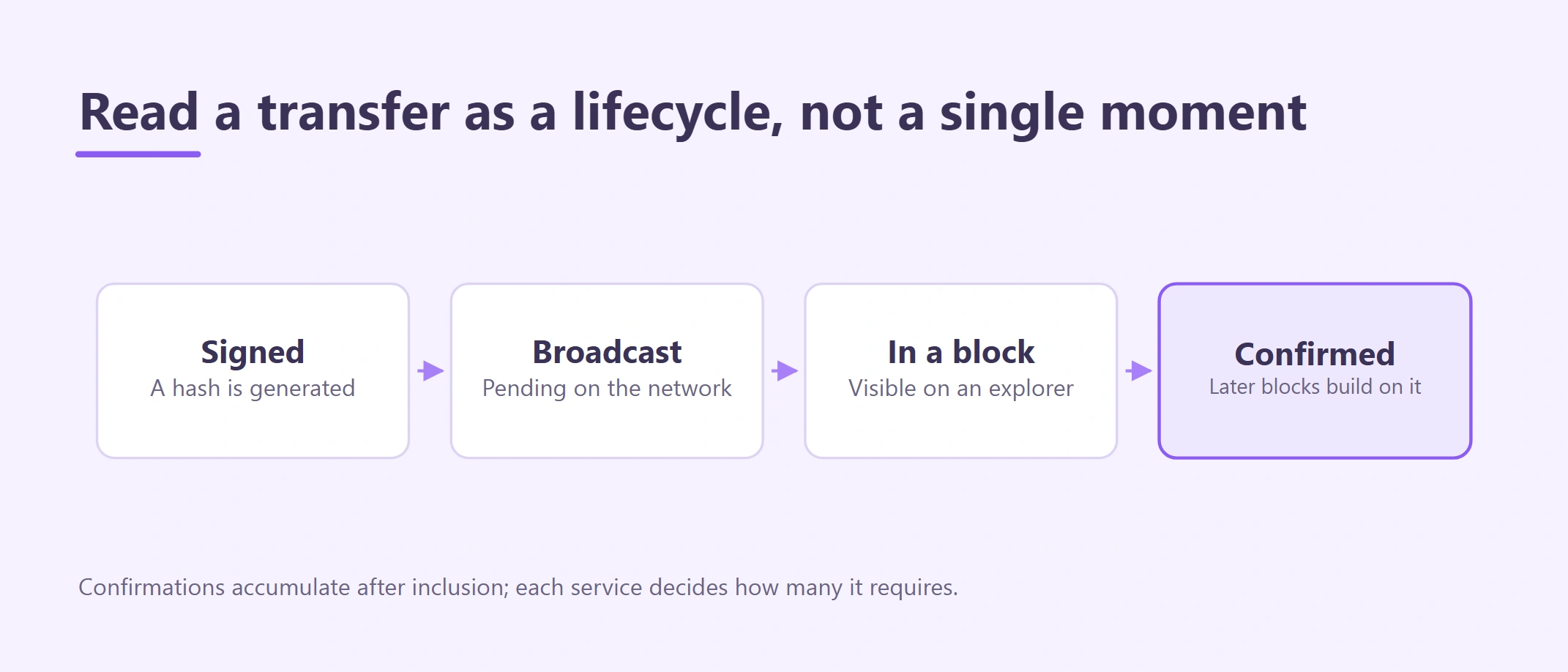
Crypto network fees and confirmations are only two parts of a valid transfer route. The exact token contract, blockchain, destination address, memo, minimum, gas asset, and receiver credit rule must also agree. This guide explains those layers before you apply them to a live payment. Official sources reviewed August 26, 2026.
A token symbol is not a payment route. “USDT” or “USDC” tells you the asset family, but it does not by itself identify the blockchain, token contract, destination, memo, fee asset, minimum deposit or number of confirmations a provider needs.
This guide gives a beginner a complete method for building a route. By the end, you should be able to write down the exact transfer details, estimate the total cost without inventing a fee, send a controlled test, read the transaction status correctly, and stop before a wrong-network transfer.
This article stays with networks, token identity, fee layers and confirmation evidence. Use the crypto test transaction guide when you are ready to validate one exact route.
Seven things you need to know before you send
| What to pin down | Question to answer | Where the answer comes from |
|---|---|---|
| Asset | What exact token or coin is moving? | Live sender and receiver plus issuer source |
| Token identity | Is it native, issued or bridged, and what is the contract/asset ID? | Issuer documentation and trusted explorer |
| Network | Which blockchain will carry it? | Live receiving route and sending route |
| Destination | Which address belongs to the receiver on that network? | Fresh receiver screen or authenticated recipient |
| Memo/tag | Is a secondary identifier required? | Live receiving instructions |
| Amount and minimum | What will be sent and what must arrive? | Invoice plus live provider limits |
| Fee and confirmation rule | What pays the transfer and when is it credited? | Live sender preview, network and receiver status |
Two addresses can look similar while belonging to different networks. One token symbol can exist under multiple contracts. A provider can also support an asset on one network but not another. Correct spelling is not enough—the whole route must match.
Verify token identity from current sources
Circle's official USDC contract page lists separate identifiers across many blockchains. Tether's supported-protocol page likewise lists USD₮ on multiple protocols and identifies deprecated ones. These lists change, so an old screenshot or copied contract can become unsafe.
Use this order:
- Open the receiver and choose the intended asset.
- Record the networks the receiver currently offers.
- Open the sender and check whether one of those exact networks is available.
- If a token contract or asset ID is relevant, compare it with the current issuer page and a trusted explorer.
- Reject look-alike tokens, bridged variants or unsupported contracts unless the receiving service explicitly accepts them.
Do not bridge a token merely because the destination network has a similar ticker. Bridging is a separate transaction with separate smart-contract, liquidity, fee and destination risks.
Write the transfer details down before you open the send form
Write the technical facts down before you open a send form. This is not a reusable address book entry; it describes one transfer, on one date.
| What to record | Where it comes from |
|---|---|
| Asset identity | Issuer, token name and current contract or asset ID where relevant |
| Blockchain | Exact network name supported by both endpoints |
| Destination format | Address type and whether a memo/tag is part of the destination |
| Fee mechanism | Native gas asset, provider deduction and who bears each cost |
| Minimum and credit rule | Amount that must arrive and the receiver’s current confirmation threshold |
| Public proof | Correct explorer and the fields it should show |
The list is complete when each value comes from a current issuer, network or provider source and the two ends agree. It explains the route; it does not prove the route works for this account today.
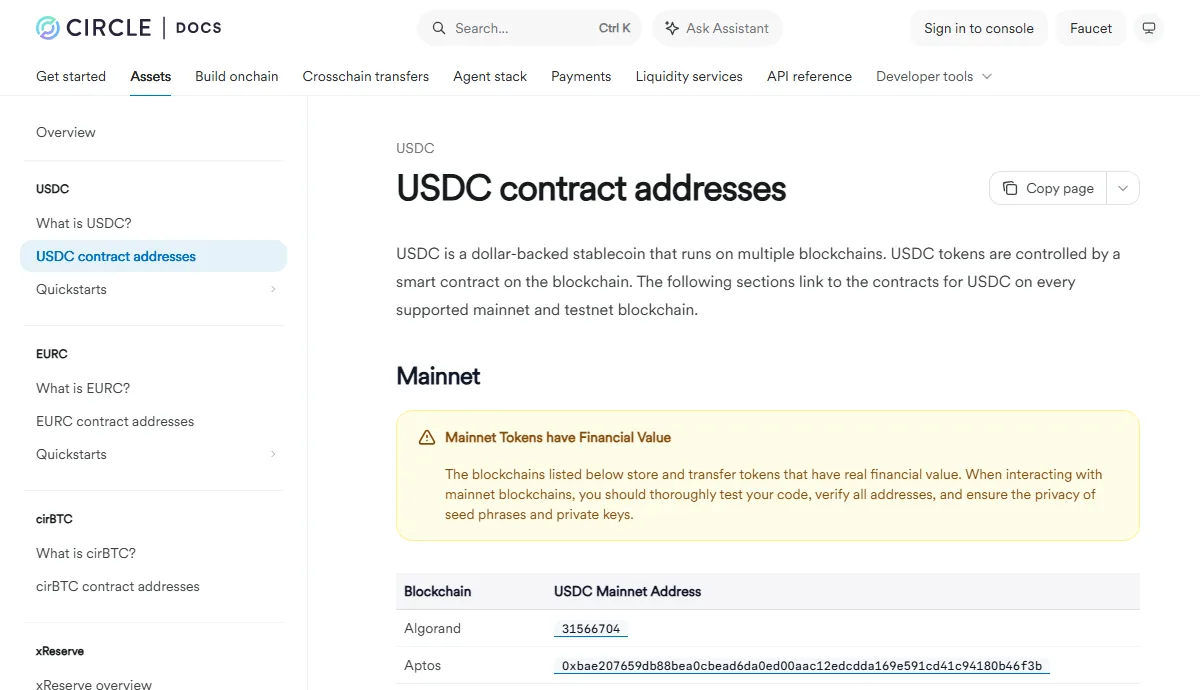
Circle Docs' public USDC contract-address page, captured 2026-08. Separate network entries show why a ticker is not enough to identify a transfer.
Understand every cost layer
The word “fee” may hide several different costs:
- Network fee: paid for blockchain computation or inclusion. On Ethereum, gas measures computation; the sender sets fee parameters and unused gas is not the same as a provider withdrawal charge.
- Provider withdrawal fee: charged by the sending exchange or service and shown in its live preview.
- Conversion spread or trading fee: incurred if you exchange fiat, stablecoins or another asset before sending.
- Bridge fee and slippage: incurred only if using a cross-chain bridge or swap route.
- Recipient minimum or credit rule: not always a fee, but an amount below the minimum may not be credited automatically.
- Cash-out cost: conversion and bank/P2P costs after the blockchain transfer.
Use two formulas:
Total sender cost = payment amount + sender-side fees + conversion/bridge costs
Expected recipient credit = transfer amount − deducted withdrawal/network fee, if the preview says it is deducted
Do not assume which side pays. Read the preview. Some wallets require the native network asset for gas even when you are sending a stablecoin. A wallet showing 500 USDC but zero native gas may be unable to move it.
What each transfer status actually proves
Different networks and providers use different words and thresholds. Do not memorize one universal number.
| Status | What it proves | What it does not prove |
|---|---|---|
| Created/signed | A wallet prepared and authorized a transaction | That it reached the network |
| Broadcast/pending | The network has seen it or a provider queued it | That it is in a validated block |
| Included/confirmed | A block contains the transaction | That the receiving provider has credited it |
| More confirmations/finality | Reversal becomes less likely under that network's rules | That asset, memo and provider account were correct |
| Sender completed | The sending service considers its job complete | That the destination has credited the right user |
| Receiver credited | The intended account balance reflects the transfer | That later conversion or bank withdrawal is available |
Ethereum's transaction documentation describes broadcast, transaction-pool inclusion, validator inclusion and later justified/finalized states. Other networks use different finality models. The receiver may wait beyond protocol inclusion for risk checks or its own confirmation policy.
For a payment, the useful completion condition is usually:
correct on-chain transaction + required confirmations/finality + intended receiver credited balance
Test the route with a small amount
Once those details are settled, check them with a small transfer above the receiver’s live minimum. The test is a separate step: it must produce a public transaction on the intended network and a credited balance at the intended destination.
Use crypto test transaction guide for amount selection, execution order, explorer checks and failure branches. Return here only if the test exposes a misunderstanding about token identity, fees, confirmations or the network itself.
A USD 500 invoice: how the costs add up
This is an illustrative calculation framework, not a real customer case or a current fee quote.
A client owes USD 500 in an agreed stablecoin. The invoice states the exact asset, network, rate rule and who bears fees.
- Let M be the receiver's live minimum.
- Let F be the fee shown in the sender's preview.
- Choose a test T so the receiver's expected credit remains above M.
- Confirm the credited test, then refresh the destination.
- If the client must deliver exactly 500 units net, the sending amount must reflect the live deduction shown in the preview; do not guess that fees are added or subtracted.
- Record test amount, main amount, F, TxIDs, timestamps and final credited total against the invoice.
If the fee or network changes between the test and the main transfer, the test no longer proves anything about the new route. Stop and write the details down again.
Use a block explorer safely
A trusted explorer can show the transaction hash, network, from/to addresses, token contract, amount, block and status. It cannot safely decide the business purpose or guarantee provider credit.
- Reach the explorer from the network's official documentation or a trusted provider link.
- Search only a public TxID or public address when necessary.
- Never enter a seed phrase, private key, password or OTP into an explorer.
- Check that the explorer belongs to the same network you recorded.
- For token transfers, inspect the token contract/asset identity, not just the displayed ticker.
Address poisoning can place a look-alike address in transaction history. Do not copy a destination from history without re-verifying it from the recipient.
Stop and diagnose failures
| What you see | Likely question | What to do next |
|---|---|---|
| No TxID | Was the transaction broadcast or held by the provider? | Check official sender status; do not submit a duplicate blindly |
| TxID pending | Is the network congested or fee insufficient? | Monitor the correct explorer and use only wallet-supported fee controls |
| Confirmed but not credited | Were network, contract, memo, minimum and provider threshold correct? | Contact the actual receiver with TxID and route evidence |
| Wrong network | Does the destination controller support recovery? | Stop; recovery may be impossible or charged. Do not send more |
| Missing memo/tag | Did funds reach a shared provider address? | Use the receiver's official recovery/support process |
| Below minimum | Does the provider offer manual credit or accumulation? | Read official policy; never assume another deposit will fix it |
| Token not recognized | Is it native/bridged/look-alike or unsupported? | Verify issuer contract and receiver support before any further action |
Blockchain transfers are generally not reversible. Anyone promising guaranteed recovery in exchange for a seed phrase, remote access or advance crypto payment is a scam signal. Review crypto scam red flags.
Reconcile the completed payment
Keep everything for one payment together:
- contract or invoice and the agreed asset/network;
- the transfer details you recorded, with the time you recorded them;
- sender fee preview and withdrawal record;
- test and main TxIDs;
- explorer status on the correct network;
- receiver credited amount and timestamp;
- exchange rate and conversion record if applicable;
- refund, short-payment or overpayment decision;
- later cash-out and bank receipt when relevant.
This lets you distinguish a network delay from a provider-credit problem and calculate the real total cost. Continue with the crypto invoice template and accepting crypto payments from abroad.
You understand this part when you can explain it
Before anyone sends a material amount, they should be able to explain:
- which exact asset and token identity will move;
- which blockchain carries it and which native asset pays gas;
- how provider fees differ from network fees and conversion costs;
- what pending, confirmed, finalized and credited each prove;
- which explorer belongs to the selected network;
- why an on-chain success may still lack provider credit;
- which changed field invalidates the earlier analysis.
That is the finish line for this guide. Testing the route and reconciling the commercial payment belong to the linked operational guides.
Official sources
- Ethereum.org: Transactions and transaction lifecycle
- Ethereum.org: Gas and fees
- Circle: Official USDC contract addresses
- Tether: Supported protocols and integration guidelines
- Circle: What is USDC?
Educational information only. Network support, token contracts, fees, limits and confirmation rules can change; verify them again for the actual transfer.