
Crypto Basics
What Is Cryptocurrency? How Cross-Border Crypto Payments Work
Learn what cryptocurrency is through one practical cross-border payment: assets, networks, wallets, fees, confirmations, cash-out, and records.
What is cryptocurrency in the context of a client payment from abroad? It is a digital asset moving through a defined payment route—not a price chart. A usable route names the asset, blockchain network, receiving wallet, fees, completion evidence, and cash-out path before either side sends money. Official sources reviewed August 26, 2026.
Cryptocurrency is a digital representation of value that can be transferred and recorded through a blockchain or similar distributed system. FATF uses the broader term “virtual asset” for value that can be digitally traded, transferred or used for payment or investment. It is not the same thing as a digital balance at a bank, and it does not automatically become legal tender because someone accepts it.
For a cross-border payment, the practical idea is simple: a payer authorizes a transfer of one exact asset, on one exact network, to one exact destination. The blockchain records the transfer; it does not verify your contract, calculate your tax, convert the token into your bank currency or settle a dispute with the client.
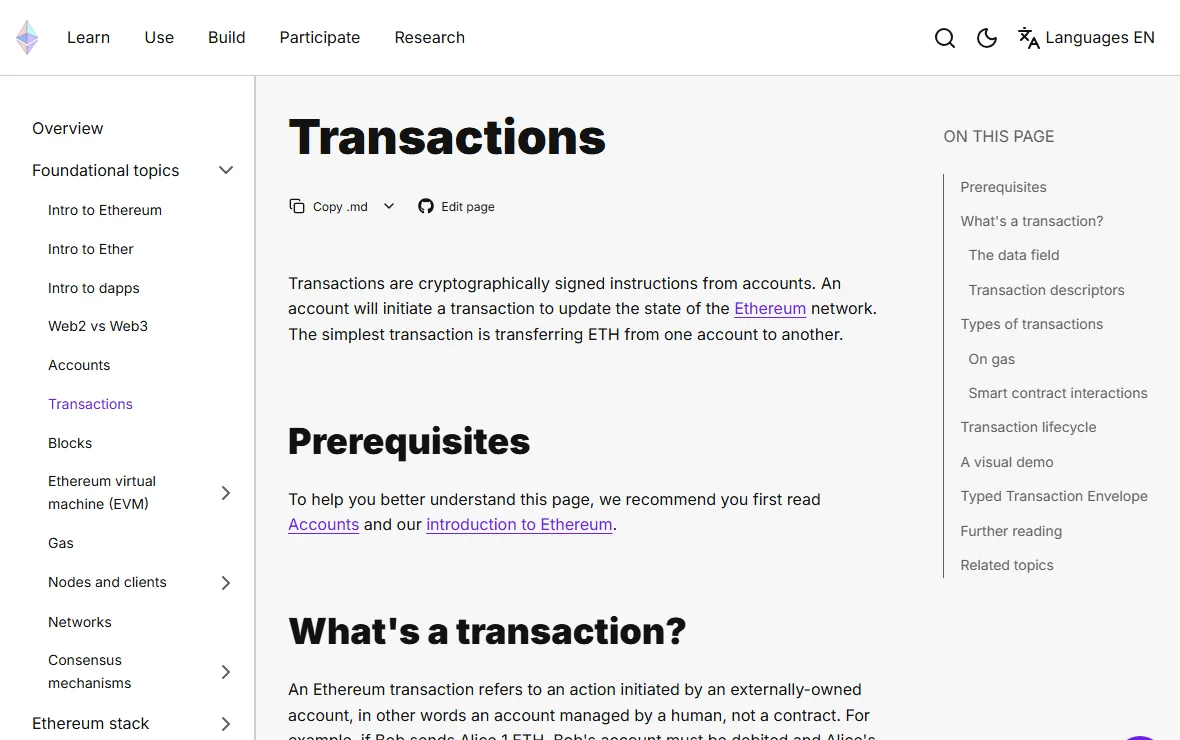
Ethereum.org Transactions documentation, captured 2026-08. This is a public documentation page—not a live wallet, personal account or claimed transaction result.
Use this guide for: understanding the full cross-border crypto-payment flow. For token choice, use the USDT vs USDC payment risks; for network mechanics, use the crypto network fees and confirmations.
What is cryptocurrency? Six things every payment depends on
| What it is | What it does | Common beginner mistake |
|---|---|---|
| Asset | The unit transferred, such as a volatile coin or stablecoin | Treating a ticker as a complete instruction |
| Network | The blockchain route that records the transaction | Choosing the cheapest-looking network without receiver support |
| Wallet/account | Displays balances and creates or receives instructions | Assuming every wallet supports every asset version |
| Address | Identifies a destination on a specific route | Retyping it or reusing an old address without checking |
| Private key/seed phrase | Authorizes control in self-custody | Sharing it with “support” or putting it in cloud notes |
| Transaction hash | Identifies a submitted on-chain transaction | Treating a screenshot or hash as proof that the provider credited it |
A custodial account lets a provider control the keys and maintain an internal account for you. A self-custody wallet gives you direct key control and direct responsibility for backups and transactions. Neither is automatically safer for everyone. Compare the operational differences in custodial vs self-custody wallet comparison.
Understand what happens after Send
The interface makes a payment look like one click, but several events follow:
- The wallet prepares an instruction containing the sender, destination, asset interaction and fee parameters.
- The sender authorizes it. In self-custody, a private key cryptographically signs the transaction; the key itself should never leave the wallet.
- The transaction is broadcast to the chosen network and waits to be selected.
- Validators or miners apply that network's rules and include it in a block or equivalent ledger record.
- More blocks or protocol events increase confidence that the result will not change.
- A receiving provider applies its own deposit policy, required confirmations, compliance checks and minimums before crediting the account.
Ethereum's current transaction documentation describes transactions as cryptographically signed instructions, notes that they require fees and explains the path from broadcast to validated block and finality. Other networks have different mechanisms and terminology, so never transfer one network's confirmation rule to another by assumption.
“Successful on a block explorer” and “available in the recipient's account” are separate checkpoints. For business settlement, use the event written in the invoice—usually correct provider credit of the required net amount.
Follow a complete USD 500 example
Suppose a designer in Cambodia bills an overseas client USD 500 for completed work.
Commercial agreement: the contract and crypto invoice template identify the client, service, USD price, due date and authorized payer. Both sides agree on a stablecoin only as the settlement asset; the work is still priced at USD 500.
Choosing the route: the designer confirms that the chosen asset and exact network are currently supported by both services, that the route is permitted for both locations, and that a lawful cash-out path exists. The designer writes down the asset, network, current destination, whether a memo or tag is needed, who pays the fee and the test amount.
Test: the payer sends a small amount above the receiving minimum. The designer waits for actual account credit and confirms the correct asset, network and amount. Read crypto test transaction guide before choosing the test amount.
Main transfer: the payer sends the balance using the verified route. The parties retain both transaction hashes. If the payer must cover sending deductions, the credited test plus main payment must equal the invoice's required token total.
Completion and records: only after provider credit does the designer mark the invoice paid. The invoice, contract, messages, rate source, fees, hashes and provider statement are linked under one reference.
Cash-out: if conversion is needed, the designer follows a currently permitted service route into a bank account in the same verified name and reconciles the gross crypto amount, rate, fees and net bank credit using the selling USDT and cashing out in Cambodia.
At no stage does the blockchain decide whether the work was satisfactory or who should bear a price difference. Those decisions belong in the commercial terms.
Calculate the real cost, not only the network fee
| Where the cost comes from | Possible charge or loss | Who should check it |
|---|---|---|
| Acquisition | Fiat deposit fee and buy spread | Payer |
| Withdrawal/send | Provider fee plus blockchain fee | Usually payer, unless agreed otherwise |
| Receipt | Deposit minimum or unusual provider deduction | Recipient |
| Market | Volatility or stablecoin depeg during the payment window | Both parties under the invoice rule |
| Conversion | Trading spread and conversion fee | Recipient |
| Off-ramp | Withdrawal fee, correspondent cost or bank deduction | Recipient |
| Tax/accounting | Reporting, tax or professional-service cost | Each party under local rules |
The displayed “network fee” can therefore be only one part of the route. Compare the amount the payer spends with the amount the recipient can actually use in bank currency. A cheap transfer that cannot be credited or cashed out is not a cheap route.
Separate stablecoins from volatile cryptoassets
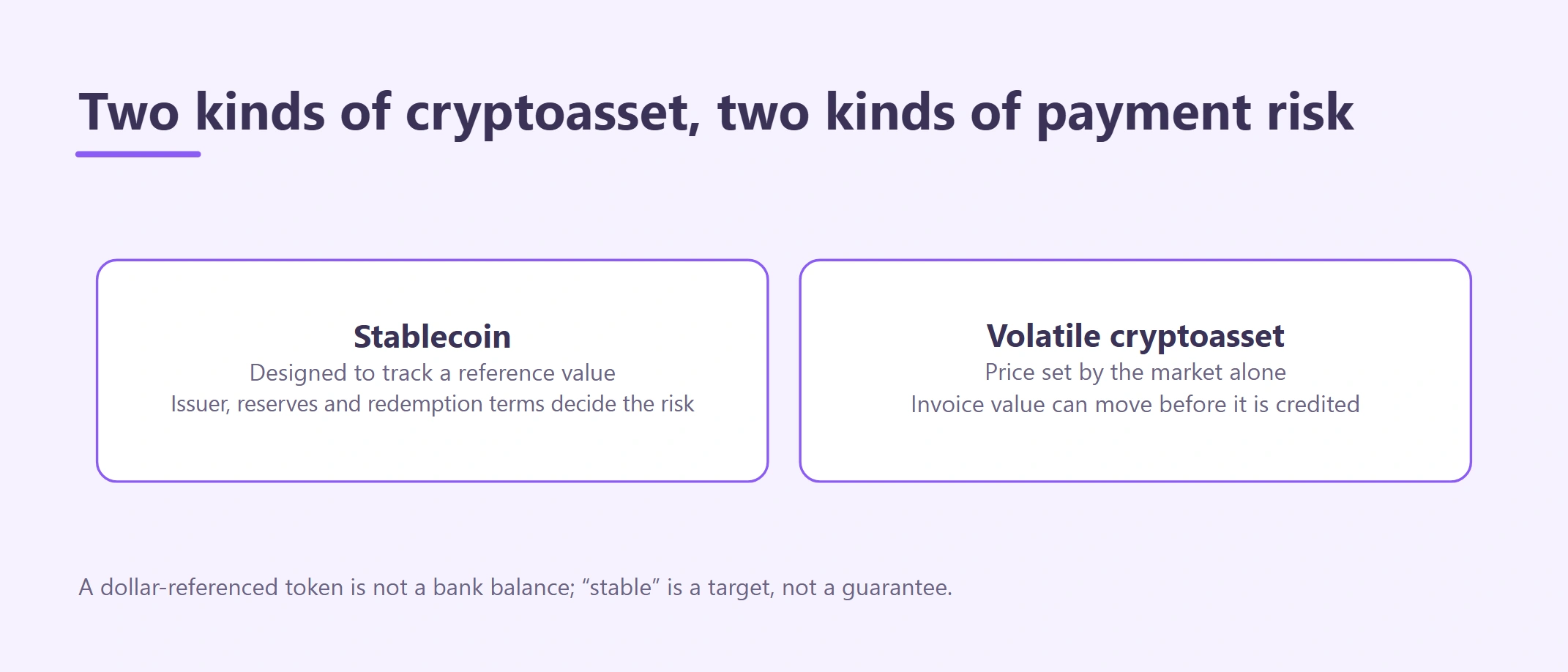
A volatile asset can change substantially between invoice, send, confirmation and conversion. A stablecoin is designed to track a reference value, often USD, which may make pricing easier. But “stable” is a target, not a guarantee: issuer, reserve, redemption, platform, network, smart-contract, market and regulatory risks still exist.
Do not choose solely between USDT and USDC by popularity. Review the full USDT vs USDC payment risks guide, then record a depeg rule in the invoice. A payment token is not a bank deposit and may not carry the protections that apply to a bank account.
Know what crypto does not solve
Crypto can provide 24/7 transfer infrastructure, but it does not guarantee:
- legality or product availability in either country;
- instant provider credit or bank cash-out;
- a fixed exchange rate or stable purchasing power;
- privacy—many public blockchains expose addresses and transaction history;
- recovery after the wrong address, token or network;
- protection from issuer, provider, wallet or smart-contract failure;
- proof that a stranger, investment scheme or “remote job” is legitimate;
- tax, accounting, sanctions or consumer-law compliance;
- reversal of an authorized transfer after a commercial dispute.
FATF notes both potential payment benefits and material scam, cyberattack and illicit-finance risks. Use the KYC, AML, sanctions and Travel Rule guide to build the evidence trail around a legitimate client payment.
Check whether the service is allowed where you are
Rules and authorization are activity-specific. An accessible website, downloadable app, old memorandum or foreign license does not prove that every product is currently permitted in Cambodia.
Before using a route:
- Review the SERC current sandbox list and the exact approved trial activity.
- Review the National Bank of Cambodia's Prakas and Circulars, including the listed Prakas on transactions related to cryptoassets dated December 26, 2024.
- Check the provider's current country eligibility and the live deposit, withdrawal and bank-transfer screens.
- Confirm that your bank will accept the intended proceeds and what evidence it may request.
- Pause for qualified local advice if your activity involves holding or transferring value for others, repeated brokerage, public solicitation or another regulated role.
Never use a false residence, borrowed identity, VPN workaround or third-party bank account to bypass eligibility.
Decide whether you are ready for the first payment
Before the payer sends anything, confirm:
- a real customer, written contract and complete invoice exist;
- the payer identity and business purpose are explainable;
- both countries and providers allow the intended activity and account type;
- the exact asset, exact network, current address and memo/tag state match;
- the quote/rate, fee allocation, depeg rule, refund rule and completion event are written;
- the destination came from a fresh authenticated receiving screen;
- a test amount exceeds any deposit minimum but limits loss if the route fails;
- the recipient can see actual credited funds before the balance is sent;
- records connect the contract, invoice, rate, transaction hashes, provider credit and bank entry;
- nobody has requested a seed phrase, private key, OTP, remote access or “unlock fee.”
If any item is unknown, pause. Crypto is optional; a conventional regulated payment route may be more suitable when the amount, evidence, refund rights or cash-out path is uncertain.
Official references
- FATF: Virtual Assets
- FATF: 2026 Targeted Update on Virtual Assets and VASPs
- Ethereum.org: Transactions
- Bitcoin.org: Bitcoin for Individuals
- SERC: Current Sandbox List
- NBC: Prakas and Circulars
Educational information only; not legal, tax, accounting, banking, investment or financial advice. Crypto can lose value and transfers may be irreversible. Verify current rules and live provider instructions for your facts.