
Crypto Basics
USDT vs USDC: Which Is Safer for Payments?
Compare USDT and USDC by issuer, reserves, redemption access, depeg risk, token contract, network support, fees, and the recipient’s cash-out route.
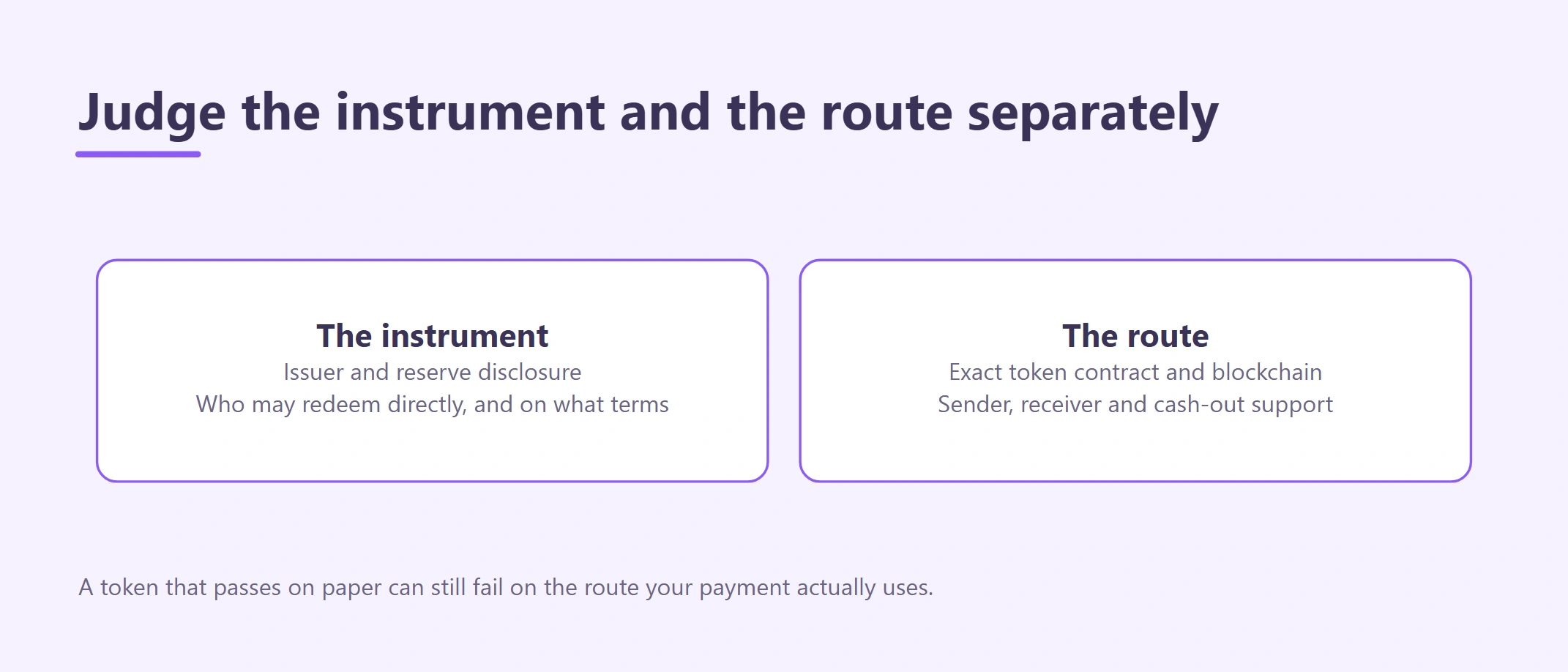
USDT vs USDC: which is safer for a real payment? There is no permanent winner. The answer depends on the issuer, reserve and redemption evidence, exact token contract, network, receiver support, and lawful cash-out route available on the day you pay. This guide turns those checks into an accept-or-reject decision. Official sources reviewed August 26, 2026.
A stablecoin is a digital token designed to track a reference value, commonly the U.S. dollar. That can make a USD-priced invoice easier to settle than a volatile cryptoasset. It does not make the token equivalent to cash in a bank account, and the word “stable” is not a promise that every holder can always sell or redeem one token for exactly one dollar.
For payments, evaluate two things separately:
- The instrument: issuer, reserve assets, redemption claim, terms, market price and legal treatment.
- The route: exact token contract, blockchain, wallet/provider support, fees, compliance review and cash-out.
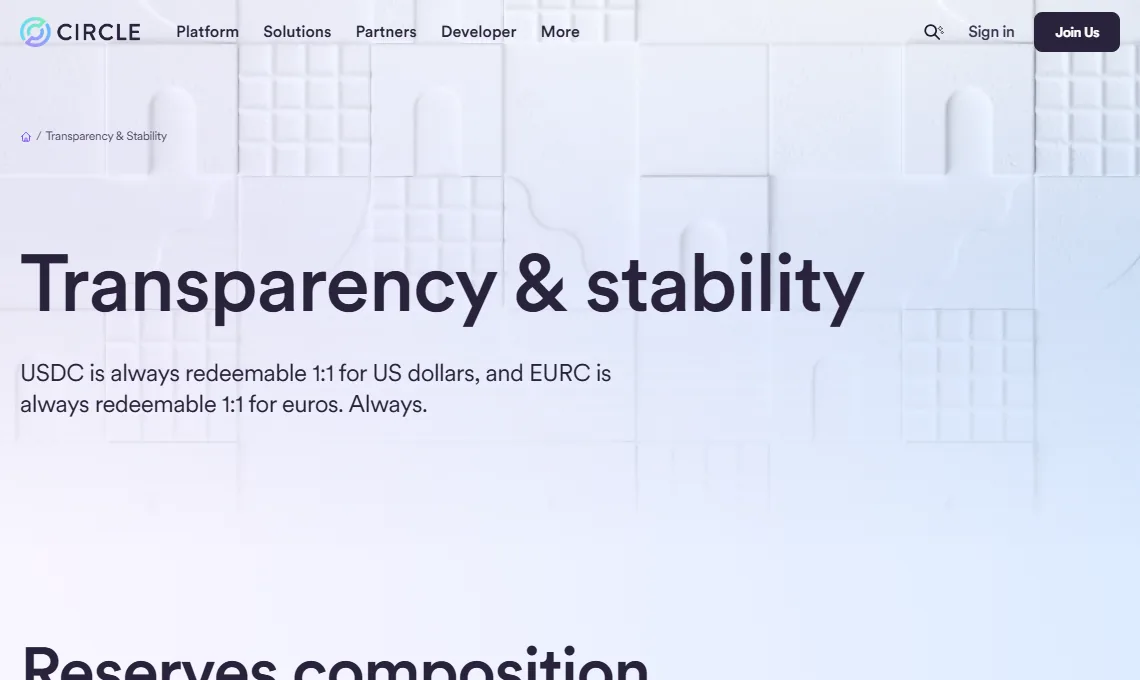
Circle's public Transparency & Stability page, captured 2026-08. Its redemption statement is Circle's own claim; direct redemption still depends on customer eligibility, current terms and the risks explained in this guide.
Use this guide for: deciding whether a stablecoin fits the payment. For chain selection and confirmation mechanics, continue to the crypto network fees and confirmations.
Understand the main stablecoin designs
| Type of stablecoin | How it tries to hold its value | What to watch for when paying |
|---|---|---|
| Fiat-reserve-backed | Issuer holds reserve assets and offers redemption under its terms | Reserve quality, issuer, banking, legal-order and eligibility risk |
| Crypto-collateralized | On-chain collateral and liquidation mechanisms support the target | Smart-contract, oracle, collateral-volatility and governance risk |
| Algorithmic or reflexive | Incentives, another token or market operations seek to maintain the peg | Can enter a rapid loss-of-confidence spiral; do not infer backing from the word stable |
| Tokenized deposit or other regulated claim | Claim may relate to a bank or regulated issuer under defined terms | Holder eligibility, transferability and jurisdiction determine the actual right |
USDT and USDC are fiat-referenced issuer-backed stablecoins, but they are different instruments with different issuers, reserve disclosures, terms, supported networks and direct-redemption eligibility. This article does not recommend either token and does not treat other designs as interchangeable.
USDT vs USDC: compare safety using current evidence
| Question | USDT evidence to inspect | USDC evidence to inspect |
|---|---|---|
| Who issues it? | Current Tether legal and product documents | Current Circle terms and product documents |
| What supports it? | Tether transparency and reserve reports | Circle transparency, reserve disclosures and assurance reports |
| Who can redeem directly? | Current verified-customer, jurisdiction, minimum and fee terms | Current Circle Mint eligibility, jurisdiction, minimum and fee terms |
| Where does it trade? | Actual liquidity and executable price on your provider | Actual liquidity and executable price on your provider |
| Which networks are official? | Tether's current supported/deprecated protocol information | Circle's current native contract-address and network information |
| Can your route use it? | Live sender, receiver and cash-out support | Live sender, receiver and cash-out support |
Tether states on its transparency page that its tokens are pegged one-to-one to a matching fiat currency and backed by Tether's reserves, and it publishes circulation and reserve information. Circle states on its USDC transparency page that USDC is backed by highly liquid fiat reserves, publishes weekly reserve information and monthly third-party assurance.
Those are issuer statements and disclosures to inspect—not substitutes for reading the terms or checking the executable market. Circle's own USDC risk factors say it does not guarantee that USDC's price on third-party platforms will always equal one dollar. A token trading near its target today can still depeg later.
Holding a token is not the same as being able to redeem it
Buying a token on an exchange and redeeming it directly with the issuer are different actions. Direct redemption may require an eligible verified institutional or business account, supported jurisdiction, bank connection, minimum amount, compliance approval and fees. If you cannot redeem with the issuer, your practical exit may depend on selling through a provider at its market price.
Therefore, ask:
- Do I have a legal claim under the issuer's current terms, or only a token held through a third party?
- Am I eligible for direct redemption in my location and account type?
- If not, which regulated or currently permitted provider can convert it?
- What happens if deposits, trading or bank withdrawals pause?
- Is the expected payment small enough for the route yet above all minimums?
Do not write “redeemable 1:1” in your own invoice as an unconditional personal guarantee. Record the payment conversion rule and who bears an agreed price difference instead.
Check the seven risks that sit behind the peg
- Reserve risk: reserve assets may vary in liquidity, credit exposure, maturity or custody.
- Issuer and banking risk: operations, banking partners, insolvency or legal orders can affect issuance, redemption or transfers.
- Market/depeg risk: exchange prices can move away from the reference, especially during stress or fragmented liquidity.
- Redemption-access risk: a holder may not meet direct eligibility, minimum, location or verification requirements.
- Smart-contract and network risk: bugs, congestion, forks, bridges or unsupported contracts can impair movement.
- Provider/custody risk: a platform may pause, restrict, review, freeze or fail even when the token contract still functions.
- Legal and compliance risk: country rules, sanctions or origin-of-funds questions can prevent use or cash-out.
The BIS Committee on Payments and Market Infrastructures notes in its cross-border stablecoin considerations that use requires attention to legal, governance, risk-management, settlement and interoperability questions. “It uses blockchain” does not remove the surrounding payment-system risks.
The same ticker can exist on several blockchains
The same ticker can appear on several blockchains, and copycat tokens can reuse a name or symbol. A provider may support a native issuer token on one network, a bridged representation on another, or neither.
Before every first payment:
- Open the recipient's authenticated Deposit/Receive screen.
- Select the asset and record the exact supported network.
- Check the memo/tag requirement and deposit minimum.
- Compare current issuer network/contract information where applicable.
- Confirm the sender supports the same route as a withdrawal, not merely as a trading balance.
- Check that the recipient can later convert or withdraw it.
- Send a crypto test transaction guide and wait for actual credit.
Never select a network because its address format looks similar. Never add a custom token using a contract copied from a search ad, unsolicited message or old article. A bridge creates additional contract and operator assumptions; do not call a bridged token “the same” without verifying what the recipient accepts.
Work through a USD 1,000 depeg example
A contractor invoices USD 1,000 and agrees to receive a dollar-referenced stablecoin. At the agreed observation time, the executable market rate is USD 0.985 per token.
Possible commercial rules produce different results:
| Written rule | Token amount | Main consequence |
|---|---|---|
| Fixed 1,000 tokens | 1,000 | Recipient receives market value near USD 985 before fees |
| Maintain USD 1,000 value | 1,000 ÷ 0.985 = about 1,015.23 | Payer supplies more tokens; rate source and time must be agreed |
| Pause outside 1% tolerance | No transfer yet | Both sides re-agree asset, rate or payment method |
There is no universally correct business choice. The mistake is leaving it unwritten. A practical clause is:
The invoice is priced in USD. If the selected stablecoin's executable price at the agreed source moves outside [tolerance] before payment, do not send. The parties will confirm a revised token amount or another lawful payment method in writing. Payment is complete only when the required net amount is credited.
Also define who bears network/provider fees, whether the test is deducted from the total, and how refunds are valued. See the crypto invoice template for the full clause set.
What to check before you accept a stablecoin payment
Record one row for each route you are considering:
| What to check | First option | Second option |
|---|---|---|
| Issuer and official asset | Verified | Verified |
| Current reserve/assurance source | Link and review date | Link and review date |
| Redemption/market exit | Exact route and eligibility | Exact route and eligibility |
| Sender support | Provider + exact withdrawal network | Provider + exact withdrawal network |
| Receiver support | Provider/wallet + exact deposit network | Provider/wallet + exact deposit network |
| Contract/native/bridged status | Verified current identity | Verified current identity |
| Deposit/withdrawal minimum | Current live value | Current live value |
| Total cost and expected net | Acquisition + send + convert + bank | Acquisition + send + convert + bank |
| Depeg/failure rule | Written | Written |
| Small test | Credited / not attempted | Credited / not attempted |
Reject a candidate if the lawful cash-out path, current provider eligibility or exact network cannot be verified. The “best” stablecoin is not an abstract global winner; it is the candidate whose instrument and complete route pass for this payment today.
Use the longer choosing a USDT or USDC network to compare total cost, then verify how you would cash out with the selling USDT and cashing out in Cambodia. If the payer, business purpose or source is unclear, stop and use the KYC, AML and source-of-funds records.
Apply Cambodia-specific checks
Before a Cambodian user relies on any stablecoin route, review the SERC current sandbox list and exact approved activity, plus the National Bank of Cambodia's Prakas and Circulars. The NBC page lists a Prakas on transactions related to cryptoassets dated December 26, 2024.
Then verify the provider's present country eligibility, account terms, product availability and bank route. A sandbox entry, old partnership announcement, foreign license or functioning app does not prove that every service is currently authorized for every Cambodian user.
Decide whether to accept this stablecoin
Do not approve the payment route until you can answer:
- Which legal issuer and exact token are involved?
- What do current reserve and assurance materials actually cover?
- Who can redeem directly, under which current terms and jurisdiction?
- What is the executable market exit if you cannot redeem directly?
- Is this native issuance or a bridged/wrapped representation?
- Do sender and receiver support the exact same network today?
- Are minimums, native gas needs, provider fees and spreads known?
- Can the recipient complete a lawful cash-out into a verified bank account?
- What price source, timestamp, tolerance and fee rule govern the invoice?
- What will both parties do after depeg, suspension, underpayment, wrong route or refund?
- Has a test transfer been credited before the main amount?
Compare USDT vs USDC fees using the net amount
A fee comparison is incomplete if it stops at the blockchain fee. Compare the amount the recipient can actually use after the full route:
Net available = credited tokens × executable sell rate − conversion cost − payout cost
Keep sender-side costs separate. If the payer adds the withdrawal or network fee on top, it does not reduce the invoice amount; if the provider deducts it from the transfer, it does. Record the treatment rather than assuming that “zero fee” means zero cost.
| Cost point | USDT route | USDC route |
|---|---|---|
| Token acquisition | Quote, spread and fee | Quote, spread and fee |
| Sender withdrawal | Live fee and whether deducted | Live fee and whether deducted |
| Network requirement | Native gas, if applicable | Native gas, if applicable |
| Receiver credit | Minimum and any deposit charge | Minimum and any deposit charge |
| Conversion | Executable rate, spread and fee | Executable rate, spread and fee |
| Bank payout | Currency, fee and expected net | Currency, fee and expected net |
Run the comparison with live previews at roughly the same time and save the timestamp and timezone. Reject a cheaper-looking route if it depends on an unsupported network, an unverified bridge, an unavailable cash-out path or a price that cannot actually be executed.
Official references
- Circle: USDC
- Circle: Transparency and Reserve Reports
- Circle: USDC Risk Factors
- Tether: Transparency
- Tether: FAQs and Reserve Reports
- BIS CPMI: Stablecoin Arrangements in Cross-Border Payments
- FATF: Virtual Assets
- SERC: Current Sandbox List
- NBC: Prakas and Circulars
Educational information only; not a recommendation, price guarantee, or legal, tax, banking, investment or financial advice. Stablecoins can lose value and access. Check current issuer terms, official disclosures and live route instructions.