
Cross-Border Payments
USDT in Your Wallet but It Won’t Send? You Need TRX, ETH or BNB for the Fee
Your wallet shows USDT but refuses to send it. The network fee is paid in TRX, ETH or BNB, not USDT. How to get a small amount in safely.
You received USDT from a client into your own wallet. Now you want to move it to an exchange to cash out, and the wallet refuses: "insufficient balance for fee", "not enough TRX", "insufficient funds for gas". The USDT is there. What is missing is a small amount of a different coin.
This guide is for freelancers and small businesses in Cambodia who hold USDT in a self-custody wallet such as Trust Wallet, TronLink or MetaMask. It explains why this happens and how to get the transfer moving without falling for the "unlock" offers that target exactly this situation.
Why USDT alone cannot pay for its own transfer
USDT is a token that runs on top of a blockchain. Every blockchain charges its transaction fee in its own coin, not in the tokens it carries:
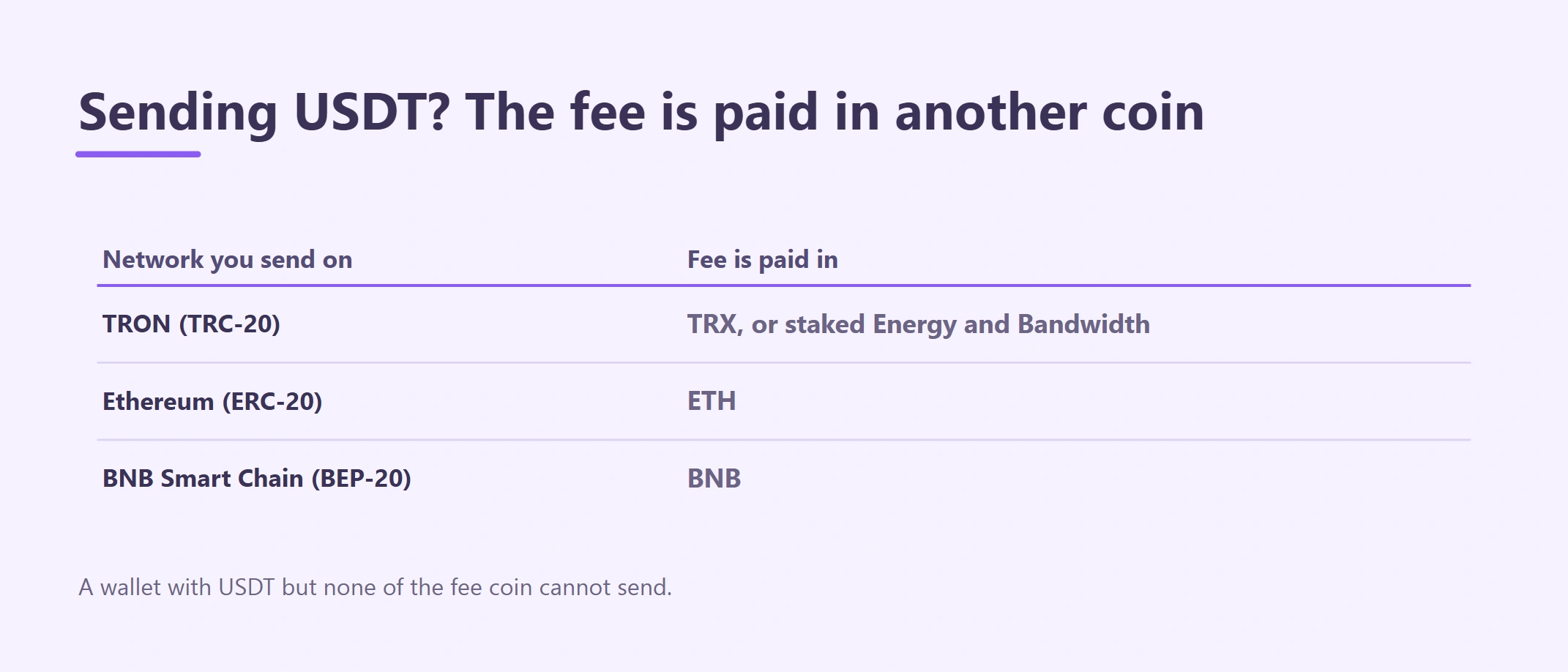
| You send USDT on | The network fee is paid in |
|---|---|
| TRON (TRC-20) | TRX, or Energy and Bandwidth you already hold |
| Ethereum (ERC-20) | ETH |
| BNB Smart Chain (BEP-20) | BNB |
So a wallet holding 500 USDT on TRON and 0 TRX can show the balance, but cannot send it. The same is true on Ethereum with 0 ETH or on BNB Smart Chain with 0 BNB. Nothing is frozen and nothing is wrong with the USDT.
On an exchange account you usually don't see this problem, because the exchange pays the network fee and charges you a withdrawal fee in the coin you withdraw. It shows up when the USDT sits in a wallet that only you control.
How TRON charges for a USDT transfer
TRON is the network most Cambodian clients use for USDT, and its fee model is the most confusing. TRON's developer documentation describes two resources that every USDT transfer uses:
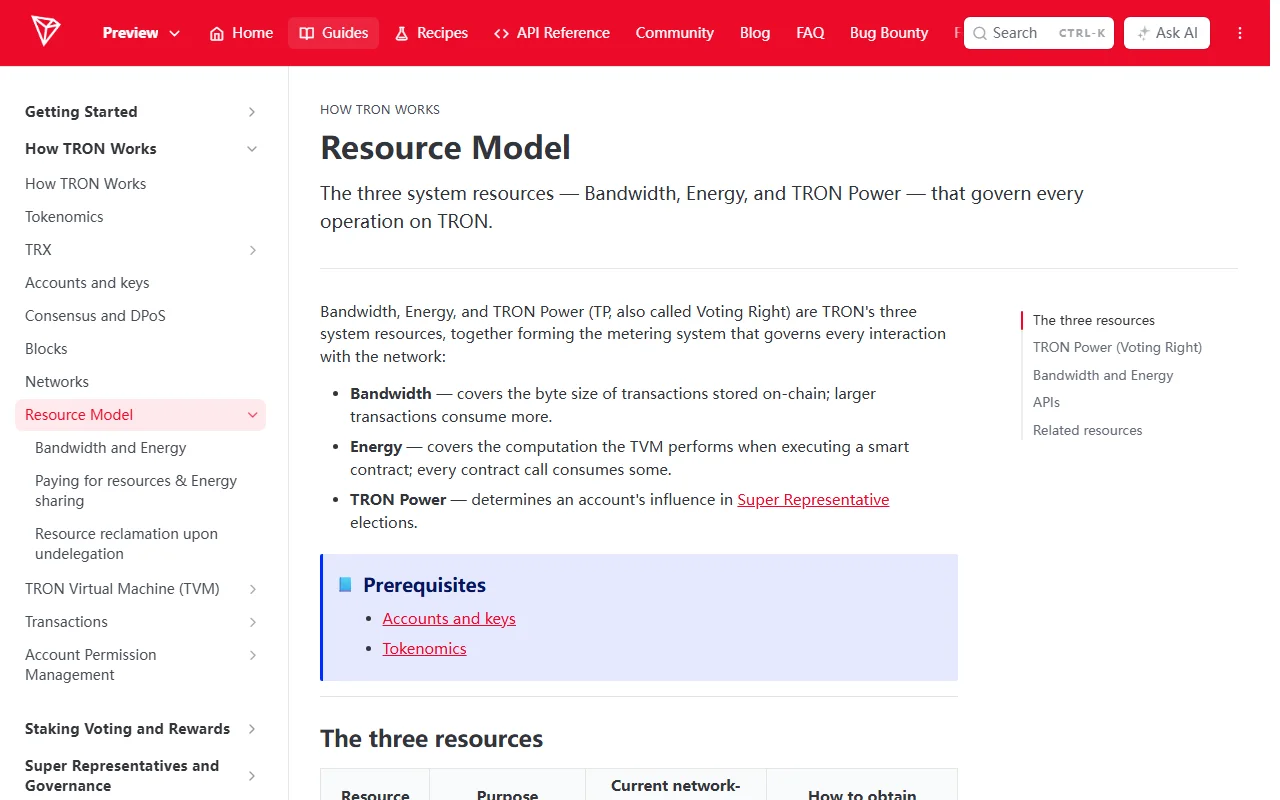
TRON's official "Resource Model" page, captured on 13 October 2026. Bandwidth covers the size of a transaction; Energy covers the smart-contract work that a USDT transfer needs.
- Bandwidth. Each account gets a small free daily allowance (the documentation says currently 600). A plain transfer can often fit inside it.
- Energy. A USDT transfer is a smart-contract call, so it needs Energy. You get Energy by staking TRX. Most small wallets have none.
When your staked resources and the free allowance don't cover the transfer, the network burns TRX from your balance instead. With no TRX, there is nothing to burn, and the wallet blocks the send or the transaction fails.
The TRX cost is not fixed. It depends on current network parameters, and it is usually higher when the receiving address has never held USDT before. Don't rely on a number from an old forum post; your wallet's confirmation screen shows the estimate for this particular transfer.
How much of the fee coin you actually need
On Ethereum the fee can be tiny. A real 200 USDT transfer on 13 October 2026 (transaction 0x53e28e11…1fb517, visible on any Ethereum explorer) paid about 0.0000028 ETH, under one US cent at that day's price. Tiny is still more than zero.
A practical way to size it:
- Start the send in your wallet with the full details filled in, and stop at the confirmation screen. Note the fee estimate and the coin it is in.
- Get roughly two to three times that amount of the fee coin. A failed transaction still uses fee, and the estimate moves between attempts.
- If you plan to move USDT out of this wallet regularly, keep a small balance of the fee coin there permanently.
For how fees and confirmations fit together on each network, see crypto network fees and confirmations.
Four ways to get the fee coin into your wallet
1. Withdraw a little from your own exchange account. Buy a small amount of TRX, ETH or BNB on your exchange and withdraw it to the same wallet address. Choose the matching network: TRX over TRON, BNB over BNB Smart Chain (BEP-20), ETH over Ethereum. Check the exchange's minimum withdrawal amount first; it may be more than the fee you need, which is fine.
2. Ask the sender to include it next time. If a regular client pays you in USDT on TRON, it is reasonable to ask them to send a small amount of TRX with the first payment to a new wallet. Agree on this in writing, not as a surprise.
3. Use a fee option built into your wallet. Some wallets offer to pay the fee in USDT, or to rent Energy for a single TRON transfer. These features exist, but terms differ by wallet and change often. Only use them from inside the wallet app you installed from its official source, and read the cost on the confirmation screen.
4. Receive into an exchange account next time. If you always cash out through an exchange, giving clients your exchange deposit address avoids the fee-coin step entirely. The trade-off is that the exchange controls the funds; custodial vs self-custody wallets weighs that choice.
Offers to avoid when your USDT is stuck
"USDT stuck, can't send" is a common search, and scammers wait on it.
- Anyone who asks for your recovery phrase or private key to "fix gas" or "activate" the wallet is stealing the wallet. No real support needs it.
- Websites that promise free gas in exchange for connecting your wallet and approving a request. An approval can give the site permission to move your USDT later.
- Strangers in Telegram or Facebook groups who offer to send you TRX if you first send them USDT "for the rate".
- Tokens that appear in your wallet with a link to "claim gas". Leave them alone.
If you have already shared a recovery phrase, move whatever is left to a new wallet immediately and report the incident; crypto scam red flags lists Cambodia's reporting channels.
Check which network the USDT is on before you top up
One more cause looks the same from the outside: the USDT may be on a different network from the one you think. If the client sent TRC-20 USDT, ETH will not help. Open the receiving transaction (the TxID from the client, see client says they paid but the USDT hasn't arrived) and confirm which network it is on before you buy any fee coin.
Once the fee coin is in place, send a small amount first and confirm it arrives before moving the rest.