
Cross-Border Payments
How to Accept Crypto Payments From Abroad for Business
Accept a crypto payment from abroad with written terms, a precise asset-network route, a test transfer, credited-balance proof, and records that reconcile.
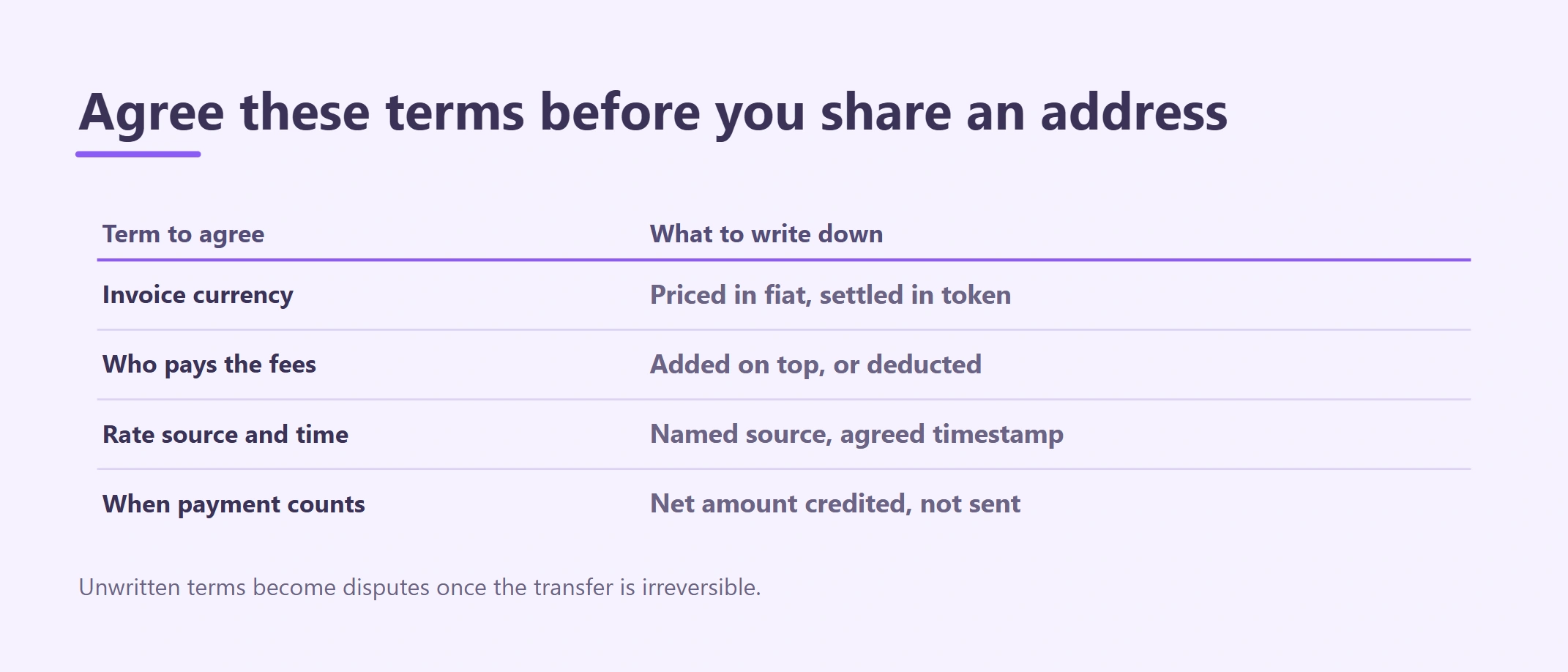
To accept crypto payments for business from a client abroad, make three records agree: the commercial agreement, the blockchain transaction, and the recipient’s credited balance. This guide connects them from the first client conversation through to matching the records, so neither side treats a wallet screenshot as proof of completion. Official sources reviewed August 26, 2026.
Receiving a cryptocurrency payment from another country involves three separate agreements: what the customer owes, which digital asset and network will settle it, and how both sides will prove completion. A wallet address alone does not answer those questions.
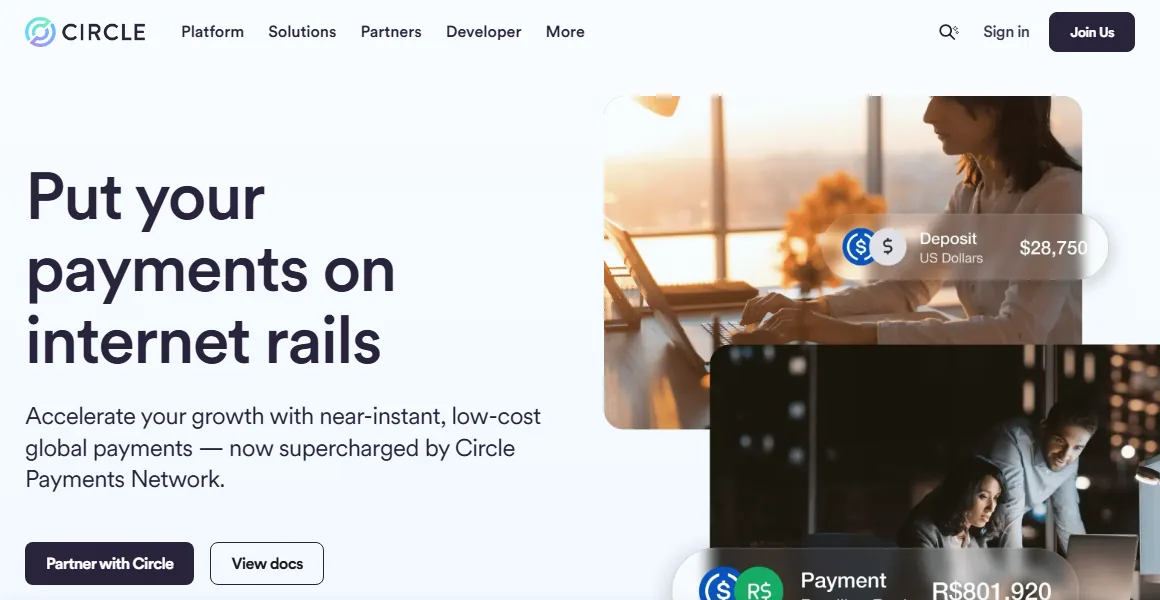
Circle's public payments page, captured 2026-08. The amounts shown belong to the page's promotional artwork; they are not our transaction, fee quote or promised result. Use the checks below for a real payment.
Use this guide for: running the payment from agreement through reconciliation. For the document itself, use the crypto invoice template; for the later bank withdrawal, use the selling USDT and cashing out in Cambodia.
Can your business accept this crypto payment route?
Before quoting crypto as a payment method, confirm:
- the payer can lawfully send the selected asset from their country and provider;
- you can lawfully receive, hold and convert it where you live;
- both services support the exact same blockchain network;
- the transaction is for a legitimate customer and documented service or product;
- neither side needs a VPN, borrowed account, false residence or third-party bank account;
- the expected amount fits both providers' limits and review requirements.
For Cambodia, check current SERC sandbox participants and authorized trial activities and the National Bank of Cambodia's Prakas and Circulars. An accessible app or an old announcement is not enough to establish current permission or product availability.
Agree commercial terms before sharing an address
Put the following in writing:
| Term | Decision to record | Why it matters |
|---|---|---|
| Invoice currency | Usually the currency used to price the work | Separates the commercial price from token price |
| Settlement asset | Exact stablecoin or cryptocurrency | Prevents the payer choosing a different token |
| Network | Exact blockchain route | Prevents a network mismatch |
| Rate source and time | How invoice currency converts to token amount | Avoids arguments during volatility or depeg |
| Fees | Who pays network and platform deductions | Ensures the intended net amount arrives |
| Test transfer | Amount, deadline and who bears its fee | Proves the route before the main payment |
| Confirmation rule | Required network/provider credit status | Defines when payment is complete |
| Shortfall/overpayment | How differences will be settled | Avoids informal address reuse |
| Refund route | Verification and who bears refund fees | Reduces refund fraud |
| Record retention | Invoice, TxID and statements to retain | Supports accounting and compliance |
Do not write “pay in USDT” without a network, amount rule and confirmation rule. Read crypto invoice template for a reusable template.
Worked example: a USD 1,350 client invoice
Assume a Cambodian freelancer invoices an overseas customer USD 1,350 for a completed website project and agrees to receive USDC.
- The invoice remains denominated at USD 1,350.
- Both sides select a network supported by the payer and the receiver's current provider.
- The invoice states the rate source and timestamp used to calculate the USDC amount.
- The payer covers the sending fee so the agreed net amount reaches the recipient.
- The parties first send a test amount above the receiver's minimum.
- The recipient confirms the test is credited inside the receiving account.
- The payer sends the balance to a freshly reconfirmed address and route.
- The recipient records invoice number, agreed amount, actual amount, fee, TxID, time and conversion result.
This example explains documentation, not tax treatment or permission to use a particular provider. The actual route must be checked on the day of payment.
Put the payment details in one message
Send the customer one complete set of instructions rather than scattered chat messages:
| What to tell the payer | What to enter |
|---|---|
| Invoice number | Your unique invoice reference |
| Recipient name | Person or business named on the invoice |
| Asset | Exact supported asset |
| Network | Exact network displayed by the receiving service |
| Address | Fresh address copied from that service |
| Memo/tag | Exact value if displayed; otherwise state not required only after checking |
| Token amount | Amount calculated under the written rate rule |
| Test amount | Above any minimum, small enough to limit loss |
| Expiry | When the quote/address must be reconfirmed |
| Completion | Credited balance plus required confirmations |
Share the address and network together. For a material payment, confirm them through a second authenticated channel. Never ask the payer to copy an address from an article or old screenshot.
Send and confirm the payment, step by step
1. Reopen the receiving screen
Confirm account identity, asset, network, deposit status, address, memo/tag, minimum and required confirmations. Stop if deposits are paused or the account is under review.
2. Authenticate the payer
Confirm the person or business matches the contract and invoice. If a new contact suddenly changes the payer, asset or destination, re-verify through the established channel.
3. Send and verify the test
The payer sends the agreed test amount. Record the TxID. You verify it on the correct explorer and wait until your provider credits the balance. A sender screenshot is not proof of receipt. See crypto test transaction guide.
4. Reconfirm the route
Compare the asset, network, address and memo against what you sent earlier. If the deposit address changed, do not automatically send the main payment; issue and confirm new instructions.
5. Send the main payment
The payer sends the remaining amount under the agreed fee rule. Do not split it into unexplained transactions to avoid provider review. Keep all related TxIDs.
6. Confirm commercial completion
Check three layers:
- Blockchain: the correct transaction exists and has sufficient confirmations.
- Provider: the receiving balance is credited and available under the account's rules.
- Invoice: the net amount satisfies the written settlement terms.
Only then mark the invoice paid or partially paid.
Reconcile the payment record
Keep one evidence folder containing:
- contract or purchase order;
- final invoice and payment instructions;
- authenticated customer communication;
- payer name and business details appropriate to the transaction;
- asset, network, receiving address record and memo/tag;
- test and main-payment TxIDs;
- receipt time, token amount and invoice-currency value;
- platform/network fees;
- later conversion and bank-withdrawal records;
- any support case or exception explanation.
This creates a traceable chain from work performed to funds received. Read the KYC, AML and source-of-funds overview before accepting recurring or higher-value payments.
Handle common exceptions
| Situation | Do first | Resolution rule |
|---|---|---|
| Test does not arrive | Stop the main payment; check network, address, memo, minimum and TxID | Continue only after credited balance or a newly verified route |
| Customer sent too little | Compare net amount with invoice fee rule | Request a documented top-up or record partial payment |
| Customer overpaid | Verify payer and original route | Refund only under written terms to an authenticated compatible route |
| Wrong asset or network | Stop and preserve TxID | Use official receiving-provider support; recovery is not guaranteed |
| Stablecoin loses its peg | Apply the agreed rate/depeg clause | Pause if no clause exists and document a new agreement |
| Payment comes from an unknown third party | Do not mark paid automatically | Obtain a lawful explanation and supporting records or return through a verified process |
| Customer asks for refund to a different address | Treat as possible refund fraud | Re-authenticate customer and document ownership/reason before any action |
| Provider requests source of funds | Gather the evidence folder | Submit only genuine requested material through the official secure channel |
Stop signals
Stop when anyone asks you to:
- accept a different network because it is “basically the same”;
- reveal a seed phrase, private key, password or OTP;
- pay an activation, unlocking or tax fee to a wallet;
- use another person's verified account;
- return an overpayment to an unrelated address;
- release goods or mark the invoice paid before the balance is credited;
- delete invoices or conceal the real business purpose.
Review crypto scam red flags before dealing with a new counterparty.
The payment is finished when all three records agree
The goal is complete only when:
- lawful provider and regional eligibility were checked;
- the customer and commercial purpose were documented;
- invoice currency, asset, network, rate, fees and refund terms were written;
- the test transfer reached the credited balance;
- the main payment used the reconfirmed route;
- blockchain, provider and invoice statuses all agree;
- exceptions were resolved in writing;
- the full accounting and source-of-funds record is stored securely.
If you plan to convert the payment to bank funds, continue to selling USDT and cashing out in Cambodia.
Send the payer one clear payment instruction
After the invoice is accepted, send one short set of instructions through the same verified business channel. This reduces the chance that a wallet address copied from an old message or a compromised email replaces the agreed route.
PAYMENT INSTRUCTION — [INVOICE NUMBER]
Amount due: [FIAT AMOUNT AND CURRENCY]
Settlement asset: [FULL TOKEN NAME AND TICKER]
Network: [EXACT NETWORK NAME]
Destination: [CURRENT ADDRESS]
Memo/tag: [VALUE OR NOT REQUIRED]
Test amount: [AMOUNT ABOVE LIVE MINIMUM]
Test treatment: [DEDUCTED FROM TOTAL / ADDITIONAL]
Quote or tolerance rule: [RULE]
Completion: credited balance of [NET AMOUNT]
Valid until: [RFC3339 TIME WITH OFFSET]
Confirmation channel: [KNOWN EMAIL, CONTRACT THREAD OR PORTAL]
Read it back with the payer before the test. If anything changes, cancel the old instructions in writing and issue a new set; never edit only the address inside an old message. These are payment details, not a place for a password, one-time code, seed phrase, private key or photo of an ID.
Official sources
- Circle: USDC
- Tether: Transparency
- Ethereum.org: Transactions
- SERC: Current FinTech Regulatory Sandbox List
- NBC: Prakas and Circulars
Educational information only, not legal, tax or financial advice. Provider access, asset support, networks, limits, fees and local rules can change.