
Cross-Border Payments
How to Choose the Right USDT or USDC Network for a Payment
Choose a USDT or USDC network by starting with the recipient’s supported destination, then comparing token identity, total fees, cash-out access, and failure points.
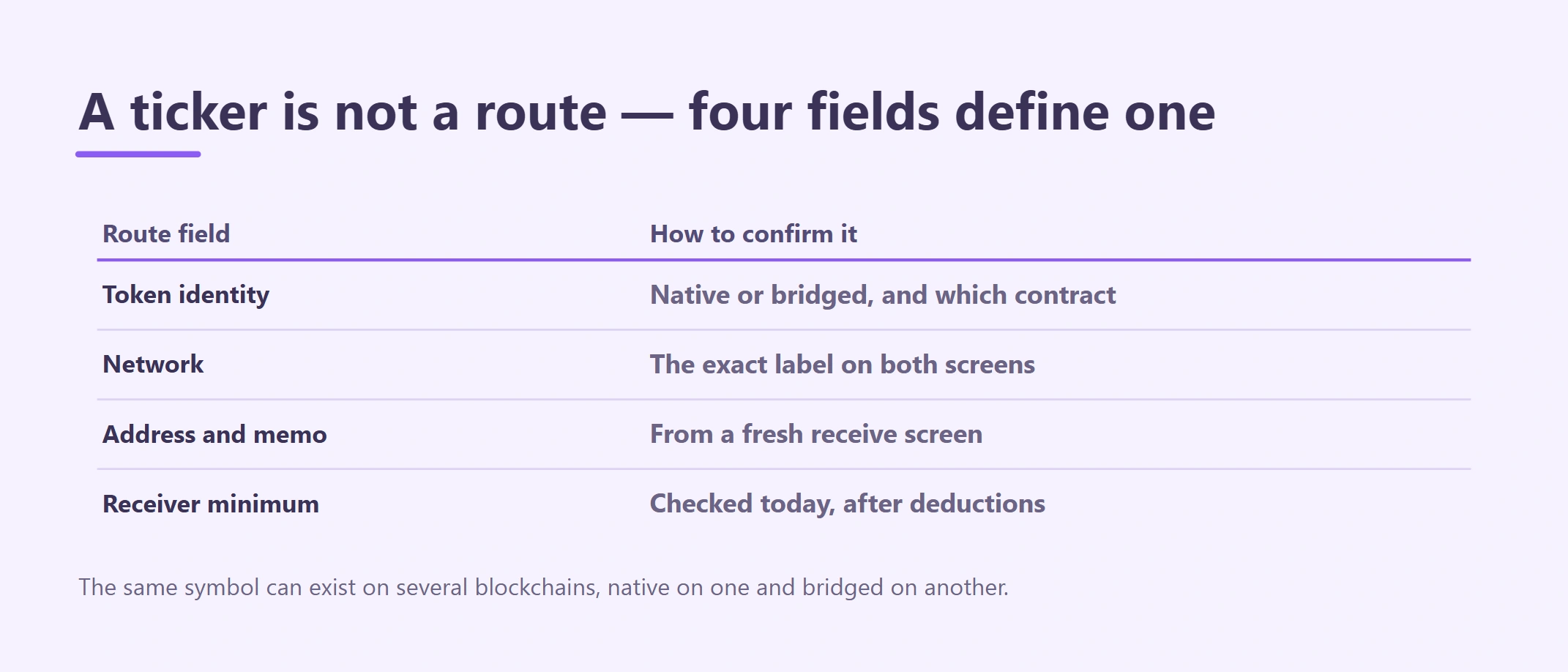
If you are deciding which network to use for USDT or USDC, begin with the recipient’s usable destination—not the cheapest option in the sender’s menu. The winning route is the asset-network pair both sides support now, at an acceptable end-to-end cost, with a lawful cash-out and record trail. Official sources reviewed August 26, 2026.
Use this comparison when several routes appear technically possible but the recipient needs one dependable result. Live sender and receiver screens remain the transaction source of truth because support, fees, token contracts and regional access can change.
This article makes the route-selection decision. The USDT vs USDC payment risks covers issuer risk; the crypto network fees and confirmations explains transaction mechanics.
Choose the USDT or USDC network as one complete route
“USDT” or “USDC” alone is not a payment instruction. The same ticker can appear on several blockchains, and a receiving service may support only some of them. A complete route contains:
- the stablecoin and issuer;
- native or bridged token identity;
- exact blockchain network;
- receiving wallet or provider;
- address and any memo or tag;
- minimum credit amount and confirmation rule;
- sender fee, recipient conversion path and bank destination.
If any field is unresolved, the route is not ready. Read the crypto network fees and confirmations before comparing options.
Begin at the receiving end
Ask the recipient to open a fresh Receive or Deposit screen in the account that will actually hold the payment. They should send the supported asset, network label, address, memo or tag requirement, minimum and any warning shown on that live screen through an authenticated channel.
The sender then checks whether their own withdrawal screen offers that exact network. Do not reverse this order. A sender choosing the cheapest menu item first can create a route that the recipient cannot credit.
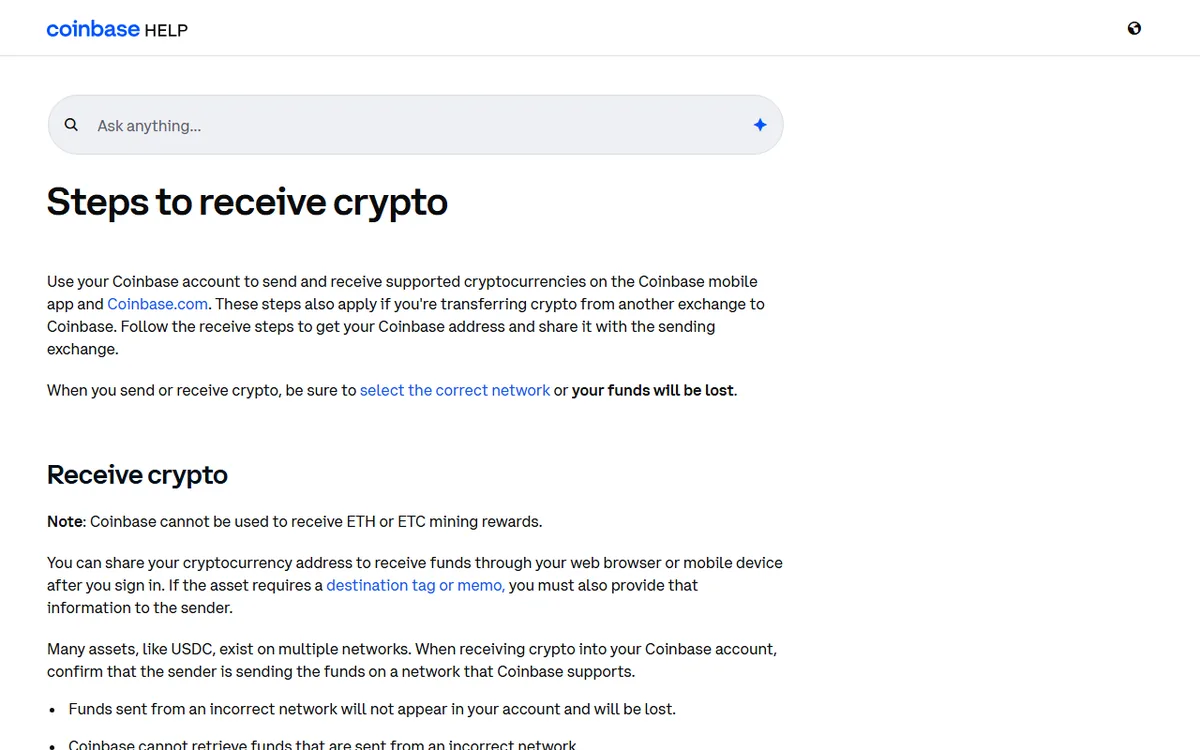
Coinbase Help, captured 2026-08. The useful point is not to use Coinbase specifically; it is that a receiving platform supports defined networks and an incorrect route may not be credited.
The screenshot is evidence of the matching principle, not a permanent list of networks. Always reopen the destination screen before a material transfer.
Compare the stablecoin before comparing fees
Issuer and token risk sit above network cost. Review each candidate using current first-party material:
| Question | What to verify | Why it matters |
|---|---|---|
| Who issues it? | Legal issuer, terms and eligible regions | Service or redemption rights may differ by location |
| What supports the peg? | Reserve disclosures and assurance reports | “Stable” describes a target, not a guarantee |
| Who can redeem directly? | Account eligibility, minimums and restrictions | Most retail users rely on a secondary market or provider |
| Can the issuer freeze tokens? | Contract and terms | Compliance action can affect transferability |
| Which token is it? | Official contract or asset identifier | Look-alike and bridged tokens can use similar names |
| Can the recipient convert it? | Current liquidity and provider support | A received balance may still be unusable for the real goal |
Circle publishes USDC contract addresses for supported mainnets, while Tether distinguishes current and deprecated protocols on its supported-protocol page. These are verification sources, not instructions to copy an address into a transaction. The live receiving service must also support that exact token and network.
If you need a fuller issuer-risk comparison, use the USDT vs USDC payment risks.
Compare networks by failure points
Once the stablecoins pass the issuer check, compare networks against the payment you are actually making:
- Receiver support: exact asset-network pair and token version.
- Sender support: withdrawal route is open, not under maintenance.
- Fee asset: a self-custody wallet may need the network’s native token for gas.
- Address format: the shape may look familiar without proving compatibility.
- Memo or tag: shared-address services may require a secondary identifier.
- Minimum and credit rule: a technically valid transfer can still sit uncredited.
- Finality and provider delay: on-chain confirmation and account credit are different events.
- Explorer and support: you need a trustworthy way to inspect a TxID and a real recovery channel.
- Exit route: the recipient must be able to use or convert the balance under current local rules.
Avoid an unfamiliar bridge merely to reduce a visible fee. A bridge adds another smart contract, interface, token representation and failure path. If the recipient already supports a native issuer-backed route, fewer unverified steps are usually easier to audit.
Work out what the recipient can actually use
The network fee is only one line. Compare routes with this worksheet:
Total sender cost = acquisition cost + payment amount + withdrawal/network charge + any bridge or conversion cost
Usable recipient value = credited stablecoin − recipient conversion spread − withdrawal/bank charges − documented tax or compliance cost
Use quotes from the actual accounts immediately before payment. Platform fees, minimums and confirmation thresholds can change, so this article intentionally does not publish a fixed comparison table.
Illustrative USD 1,200 invoice
This is a calculation example, not a real customer case or current price quote.
A client owes USD 1,200. Route A advertises a lower network fee but requires the recipient to bridge and then convert. Route B has a higher visible withdrawal charge but credits directly to the recipient’s verified conversion provider.
For each route, record the live sender total, expected credited amount, bridge or swap cost, conversion quote, bank withdrawal cost and time/risk dependencies. Choose only after comparing the final usable value and the number of failure points. A small difference in the first fee can be overwhelmed by a second conversion or an unsupported deposit.
Compare the routes side by side
Compare only routes that both ends currently support. Give each option a dated row rather than declaring one network universally best.
| What decides it | First option | Second option | Rule it out when… |
|---|---|---|---|
| Recipient can credit it | Current destination evidence | Current destination evidence | Support is absent or ambiguous |
| Sender can withdraw it | Live withdrawal option | Live withdrawal option | Route is suspended or unavailable |
| Token risk is acceptable | Issuer and token evidence | Issuer and token evidence | Identity or bridge risk is unresolved |
| End-to-end cost | Acquisition + transfer + exit | Acquisition + transfer + exit | Net receipt misses the requirement |
| Cash-out and records | Usable destination and evidence | Usable destination and evidence | Exit depends on an unverified intermediary |
Choose the route that survives every rejection rule and best fits the recipient’s real destination. Keep the runner-up only as a documented fallback; switching routes later requires a fresh check.
Test the route you chose before the real payment
Choosing narrows the options; it does not prove the route works for the two live accounts. Open fresh sender and receiver screens, confirm nothing has changed, then run a small test and wait for it to be credited.
The crypto test transaction guide covers how to size the test, what order to do it in and what counts as a pass. If the test fails, go back to the comparison and either correct the evidence or rule that option out—do not quietly substitute a different network.
Know when not to send
Stop rather than improvise when:
- the sender and receiver use different network labels;
- the token contract cannot be verified from the issuer and destination;
- a deposit or withdrawal route is suspended;
- a memo/tag requirement is unclear;
- the recipient cannot explain how the balance becomes usable funds;
- a “support agent” requests a secret, remote access or advance payment;
- the test is confirmed on-chain but not credited to the intended account;
- a provider or cash-out route is not currently available in the recipient’s region.
For a Cambodia-facing route, verify current providers and permitted services through the relevant official regulator pages before relying on a cash-out path. The selling USDT and cashing out in Cambodia explains that separate check.
Write down why this route won
The decision record should name the chosen asset-network pair, the recipient’s usable destination, the alternatives rejected, the end-to-end cost estimate, the cash-out path and the date of the live checks. It should also state what change would force a new decision.
A route has won the comparison when both endpoints support it, the token and intermediary risks are understood, the recipient can use the net amount, and the evidence can be reconciled. Actual transfer completion is established later by a credited test and the payment record.
Current first-party references used for this review:
- Circle: official USDC contract addresses
- Tether: supported protocols and deprecated routes
- Coinbase Help: steps to receive crypto
- Coinbase Help: supported assets and networks
Educational information only; not financial, legal, tax or investment advice. Stablecoins can depeg, providers can restrict service and route support can change.