
Security & Compliance
Seed Phrase vs Private Key: Wallet Safety Explained
Learn the difference between a seed phrase and private key, what a wallet address and password protect, what may be shared, and how to respond to exposure.
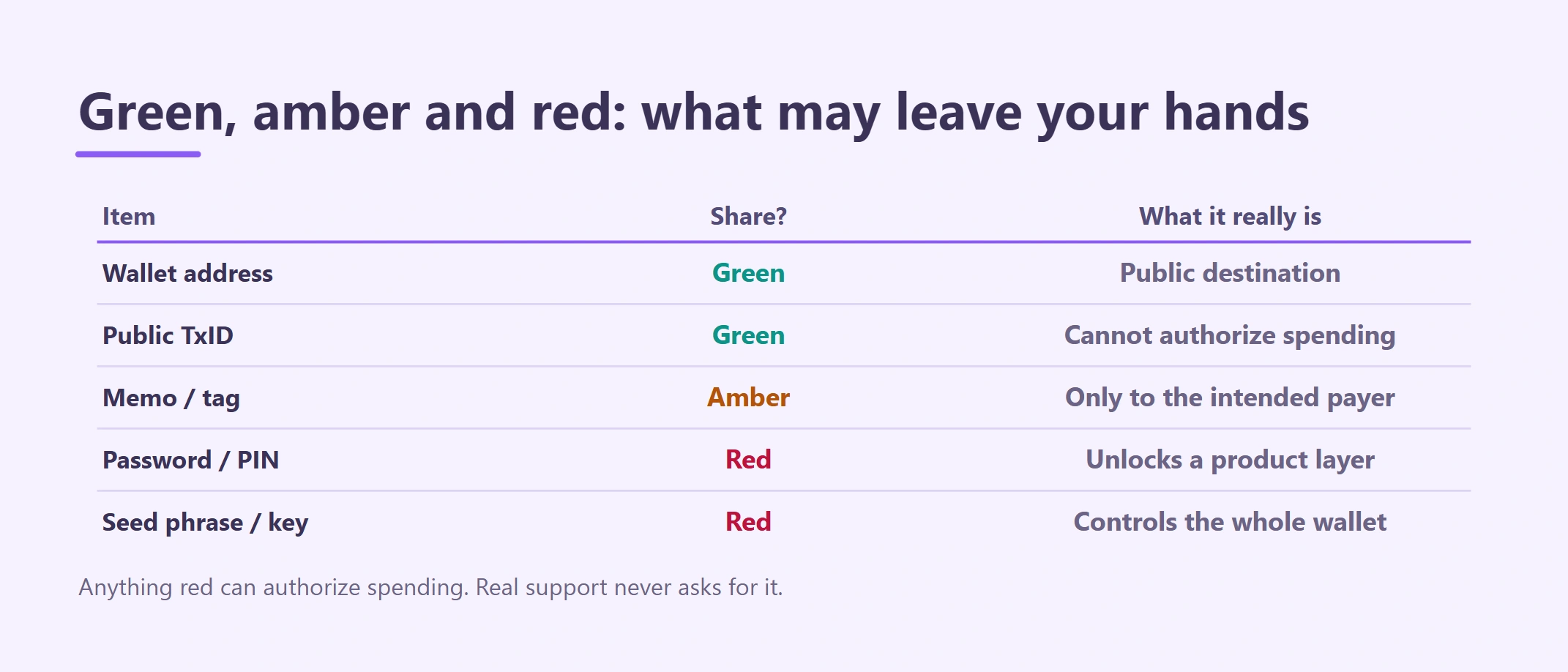
A seed phrase vs private key comparison starts with scope: a private key authorizes spending from one account, while a seed phrase may recreate many keys and accounts in a wallet. A payer needs only your receiving address—not either secret, your wallet password, PIN, one-time code, or remote access. Official sources reviewed August 26, 2026.
This guide explains what each wallet credential does, what may be shared, what can be recovered, and how to respond if a secret may have leaked. It is about operating a wallet safely, not choosing an investment. Ethereum.org pages and screenshots reviewed on August 26, 2026.
Use this guide for: classifying wallet credentials and responding to exposure. To decide between a custodial account and your own wallet, use the custodial vs self-custody wallet comparison.
Use the green, amber and red rule
| Item | Sharing rule | What it controls or reveals |
|---|---|---|
| Wallet address | Green for receiving, after network checks | Public destination; may reveal on-chain history and balances |
| Public TxID | Green when needed | Public transaction details; does not authorize spending |
| Memo or tag | Amber: share only with the intended payer | Routes a deposit inside some custodial services |
| App password or PIN | Red: never share | Opens or decrypts a local app/device, depending on the product |
| Exchange password/OTP | Red: never share | Authenticates a custodial account or action |
| Private key | Red: never share | Usually authorizes one blockchain account |
| Seed/recovery phrase | Red: never share or photograph | Can restore and control all accounts derived from that phrase |
“Support,” a client, an employer and a wallet checker do not need a red item to send you money or inspect a public transaction.
A wallet address is public, not harmless
A wallet address is designed to receive assets on a particular network. You may place it on an invoice or send it through an authenticated conversation. It normally cannot authorize spending by itself.
Still, do four checks:
- Pair it with the exact asset and network.
- Copy it from a fresh receive screen, not transaction history.
- Compare the full value or use a trusted second display; first-and-last characters are only a quick check.
- Remember that public explorers may reveal balances, counterparties and timing.
Address poisoning places look-alike addresses in public history. A familiar prefix is not proof. For business reconciliation, use a wallet/provider feature that assigns references or addresses safely rather than inventing an address-handling system.
Seed phrase vs private key: what each one controls
A private key is a secret cryptographic value used to sign for an account. Anyone who obtains it can usually move that account’s assets without the app password. Changing a local PIN does not neutralize an exposed private key.
Do not paste a private key into:
- a web form claiming to validate or synchronize a wallet;
- chat, email, cloud notes or a shared password vault;
- a block explorer or support ticket;
- software reached through an advert or unsolicited message.
If a legitimate wallet import requires a key, start from the wallet project’s verified official source and follow its own documentation in a private environment. Importing still exposes the key to that device and software, so it should not be a casual troubleshooting step.
A seed phrase can control a whole wallet tree
A seed phrase—also called a recovery phrase or secret recovery phrase—is a human-readable backup used by many wallets to derive multiple accounts and private keys. Exposure may therefore compromise more than the address currently visible on screen.
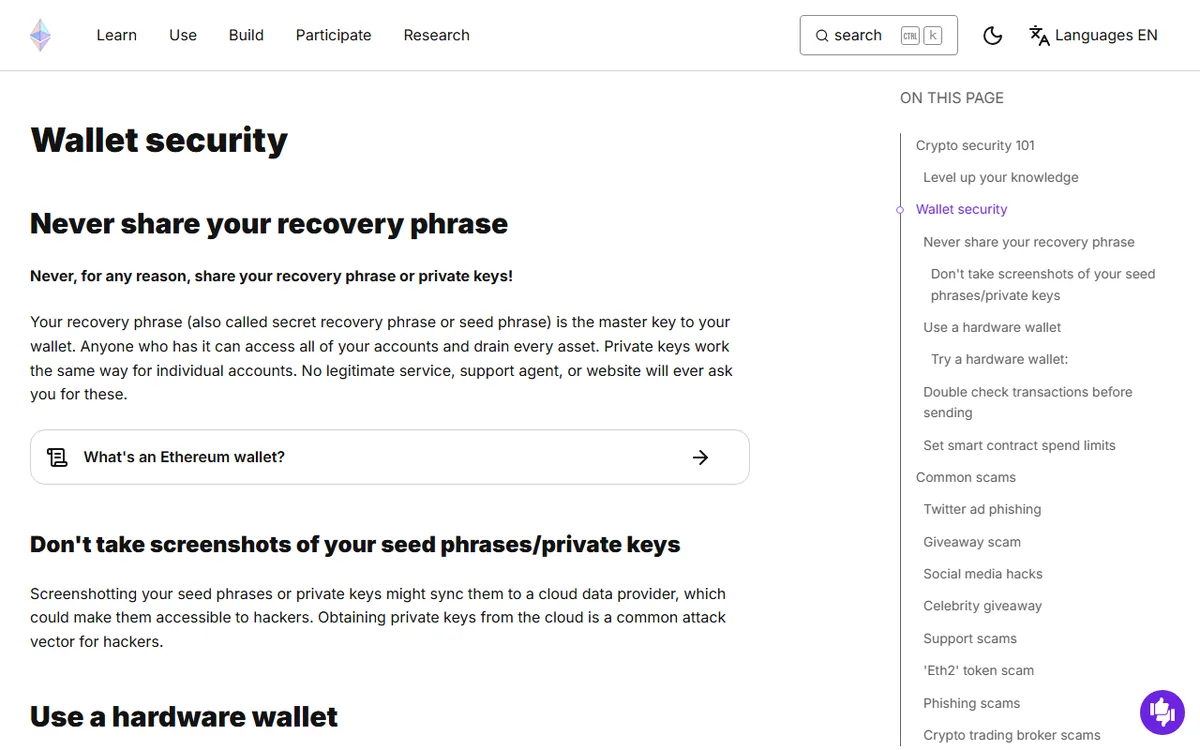
Ethereum.org Security, captured 2026-08. The page states that recovery phrases and private keys must not be shared and warns that screenshots may sync to cloud storage.
Never type a phrase because someone says they will:
- verify a wallet;
- recover a failed transfer;
- release a frozen payment;
- migrate or upgrade a token;
- connect customer support;
- qualify you for a refund or giveaway.
A real payer can send to a public address. A real block explorer can inspect a public TxID. Neither needs the master secret.
A password protects the app, not the blockchain account
“Password” can mean different things:
- a local wallet password may encrypt an app or key file on one device;
- a device PIN may only unlock the phone;
- an exchange password authenticates an account held by a provider;
- an OTP or passkey approves a login or sensitive action.
None is automatically a blockchain recovery key. A self-custody app password may be reset only by restoring with the recovery phrase. A custodial provider may offer account recovery after identity checks because it controls the underlying signing system.
Never test the distinction by deleting an active wallet. Read the exact product’s recovery documentation before funds arrive.
Make a backup without creating a second attack path
A backup should survive device loss without becoming easy to copy.
- Create the wallet on a clean, updated device from the verified official source.
- Work privately: no screen sharing, cameras, browser extensions or observers.
- Record the recovery material exactly as the wallet instructs, offline.
- Check word order and spelling without photographing or uploading it.
- Store it where theft, fire, water and unauthorized access are considered.
- Do not put the secret itself in a business spreadsheet, a note of payment details, or an inheritance document.
- Record only the existence and location/access procedure in an appropriate protected plan.
Some hardware or smart-account products use different backup methods. Follow the product’s current official instructions; do not force a seed-phrase routine onto a wallet that does not use one.
Test recovery before the wallet holds important value
A backup you have never tested is an assumption. Perform any recovery exercise only with an empty or negligible-value wallet, on a clean device, using the wallet provider’s verified procedure.
The objective is to confirm that the backup restores the expected public address without exposing the secret elsewhere. Do not enter the phrase into a random “checker.” After the test, remove temporary wallet data according to the product guidance and secure the offline backup again.
If you cannot explain the recovery process safely, choose a different custody model before receiving a material payment. The custodial vs self-custody wallet comparison compares those responsibilities.
Respond to suspected exposure in the right order
Seed phrase or private key may be exposed
Treat the affected self-custody wallet as compromised. From a clean environment, create a new wallet with a new recovery secret, verify it, and move assets through the correct network route. Do not keep receiving into the old address. Avoid unsolicited “recovery experts.” If malware or physical compromise is possible, get qualified incident help without revealing the secret.
App password or device PIN may be exposed
Secure the device, remove unknown access, update software and change credentials from a trusted environment. Then determine whether the underlying seed/private key was also accessible. Changing the app password is insufficient if the master secret was copied.
Custodial account password or OTP may be exposed
Use the provider’s official security channel from a known device, secure the connected email, revoke unfamiliar sessions or API keys, and follow the provider’s incident procedure. Never follow a support link sent by an unknown person. The securing a Binance account covers one provider-specific example.
Putting it together: getting paid to your own wallet
Suppose a client needs to pay an invoice to your self-custody wallet. This is an illustrative example, not a claim about a real customer.
- You agree on the stablecoin, exact network and fee responsibility in writing.
- You generate a fresh receiving address in the intended wallet.
- You share the address and network—not the seed phrase, key, password or OTP.
- The payer sends a small test above any applicable minimum.
- You verify the public TxID on the correct explorer and confirm the credited wallet balance.
- Both sides recheck the route before the main payment.
- You preserve the invoice, test and main TxIDs, and credited amounts.
Use the accepting crypto payments from abroad and crypto test transaction guide for the rest of the task.
If more than one person handles the wallet
A business wallet should not depend on one person remembering a phrase. Write a continuity plan that answers:
- who may authorize a payment and under what approval rule;
- who can access recovery material and under what emergency condition;
- how duties are separated so one person cannot both request and approve a payment;
- how staff departure, device loss and suspected compromise are handled;
- where public addresses, invoice references and TxIDs are recorded without storing secrets;
- whether a multi-signature or institutional custody design is appropriate.
Do not email the seed phrase to a second employee and call that redundancy. Use a custody design built for shared responsibility, obtain specialist advice when amounts justify it, and test the continuity process without exposing production secrets.
You are ready only when every red item stays private
Before receiving meaningful value, confirm that:
- you can identify the public address and correct network;
- you understand which key or provider authorizes spending;
- the recovery method has been tested safely with no important balance at risk;
- no screenshot, cloud note, chat or form contains the seed phrase/private key;
- device, email and custodial account security are separate and strong;
- a suspected-exposure procedure is written;
- a small test reaches the intended balance;
- business records contain public evidence, not wallet secrets.
Current first-party references:
Educational information only. Recovery behavior differs by wallet. Use the exact product’s current official documentation and never disclose a seed phrase or private key to obtain support.